


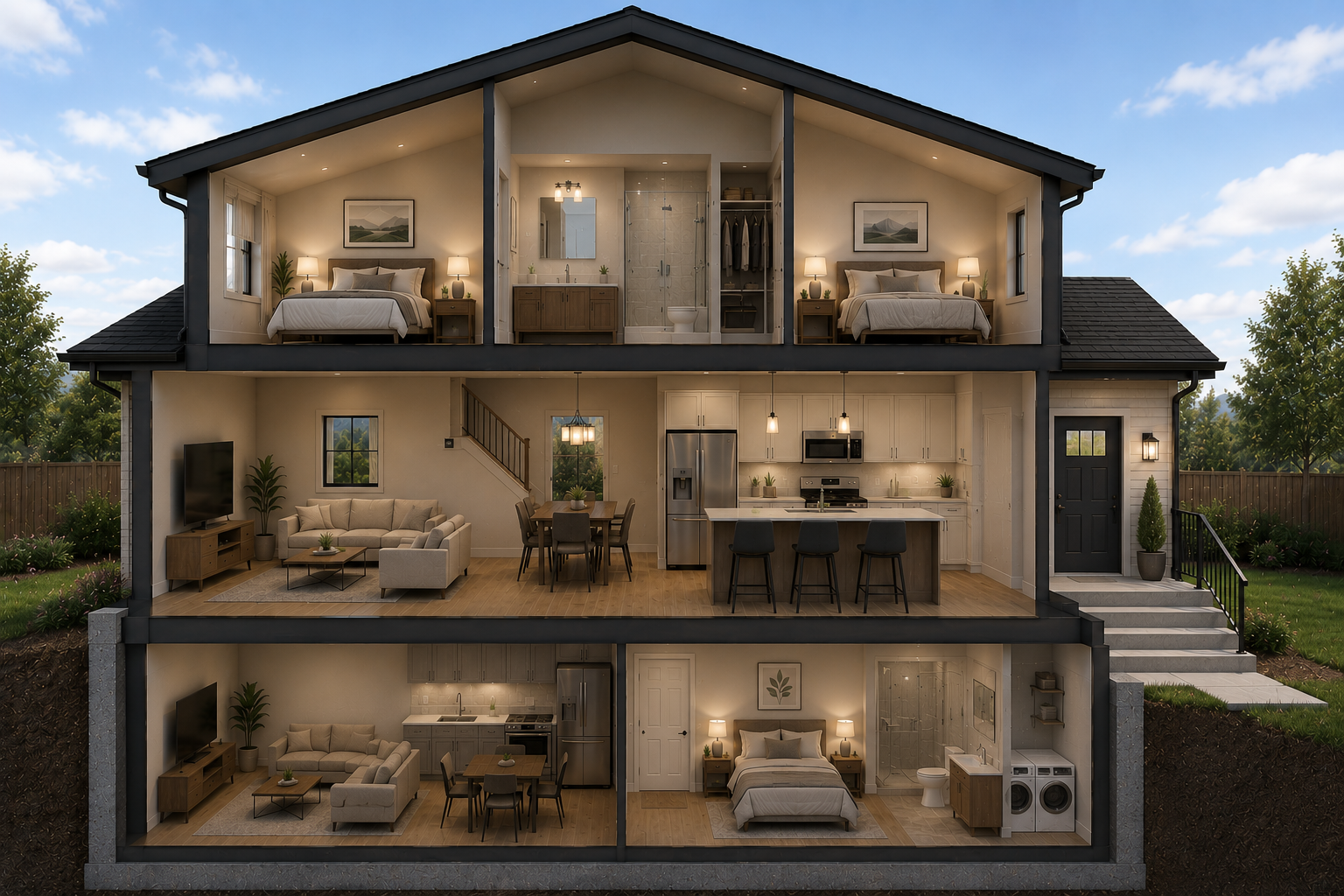
A legal basement apartment in Lehi can generate $1,600–$2,200 per month in rental income — potentially $20,000+ per year — while lowering your effective mortgage payment and building long-term equity.
Per Pro-Worx Construction's March 2026 Utah basement apartment ROI guide, rental demand across Utah County is strong enough that many homeowners find a legal basement apartment begins paying for itself faster than most other home renovations. Unlike kitchen or bathroom upgrades — which primarily affect resale value — a rental unit generates monthly cash flow from day one.
But here's what stops many Lehi buyers and homeowners cold: some Lehi neighborhoods have active moratoriums on new ADU permits due to sewer capacity constraints. You can own a qualifying property, meet every city requirement, and still be denied. And Lehi requires a formal legal document — a Declaration of Owner Occupancy — recorded with the Utah County Recorder's Office before anyone can legally live in the unit.
Both issues are fixable. Neither is something to discover after closing.
Here's everything you need to know, sourced directly from the Lehi City ADU FAQ and City Ordinance Chapter 26.
What Lehi Allows
Per the Lehi City ADU FAQ, ADUs are permitted in owner-occupied, single-family homes in qualifying zones. Both internal (basement) and detached ADUs are permitted — subject to the requirements below.
ADUs are NOT allowed in:
- Resort Communities
- Planned Communities
- Properties with townhomes, duplexes, or other types of multi-family housing
Contact Lehi Planning Division at 385-201-1030 to verify zoning for your specific property before you plan anything.
The Sewer Moratorium Issue — Check This First
This is the most important section in the post for buyers.
Property Focus's December 2025 Utah ADU analysis documents it directly: "Cities like West Jordan and Lehi have implemented moratoriums on new ADU permits in certain neighborhoods due to sewer capacity constraints." And Engage Lehi's own public planning record confirms that restrictions on where internal ADUs are allowed are based on limited utility capacity in certain areas.
Per Property Focus, infrastructure bottlenecks can add $10,000–$25,000 to project costs and aren't always apparent during initial planning.
Before you buy a Lehi home with ADU intent — or before you start planning a unit — call Lehi Planning at 385-201-1030 and confirm:
- Whether your specific neighborhood has an active ADU moratorium
- Whether sewer capacity at your address can support an ADU
On r/FirstTimeHomeBuyer and Utah County Facebook homebuying groups, discovering a moratorium after purchase is one of the most frustrating ADU stories shared by Lehi homeowners. Do this call first.
The Requirements at a Glance
Minimum lot size:
- Internal ADU: 6,000 square feet
- Detached ADU: 22,000 square feet (just over half an acre), with an all-weather access road and all utilities connecting to the primary dwelling
Per the Engage Lehi code amendment record, Lehi reduced its internal ADU minimum lot size from 8,000 to 6,000 sq ft in 2021 following state legislation (House Bill 82).
Owner occupancy — and a recorded legal document: The homeowner must live in the home. Per the Lehi FAQ, a Declaration of Owner Occupancy must be signed and recorded with the Utah County Recorder's Office. This is a formal legal step — not just a policy acknowledgment. The Planning Division records the document on your behalf; contact them at 385-201-1030 to obtain the form.
No size restriction for internal ADUs: The Lehi FAQ confirms there is no size restriction for an internal ADU.
One ADU per lot maximum.
Parking: At least one additional off-street parking stall is required per ADU.
Tenants don't need to be related to you: Per the Lehi FAQ, the inhabitants of the ADU do not need to be related to the homeowner.
No short-term rentals: ADUs may not be rented for less than 30 consecutive days. A separate short-term rental application is required for that use — though both can be approved for the same property.
What It Costs to Build — and What You Can Earn
Per Pro-Worx Construction's March 2026 ROI guide, most legal basement apartments in Utah cost $85,000–$120,000+ to build, depending on layout, kitchen installation, HVAC zoning, and whether a separate entrance must be constructed.
Property Focus notes that separate utility meter requirements — if needed — can add $5,000–$15,000 to project costs, especially in older neighborhoods with electrical service limitations.
The income side: Across Utah County, basement apartments rent for $1,600–$2,200 per month in 2026 depending on location, square footage, private entrance, and parking, per Pro-Worx's market analysis. At these rates, the average Lehi basement apartment generates $20,000+ per year in rental income.
Pro-Worx also notes that walkout basements in competitive areas like Lehi command $300–$600 more per month than standard basement apartments — because the built-in separate entrance, natural light, and easier legal rental conversion are genuinely worth more to tenants. And homes with walkout basements typically sell 5–10% higher than comparable homes without one, because they appeal to buyers looking for rental income or multi-generational living.
What Happens When You Sell a Home With an ADU
Per the Lehi FAQ, when a home with a permitted ADU is sold, the new owner must sign and record a new Declaration of Owner Occupancy. The ADU permit itself remains valid — but occupancy cannot legally continue until the new owner completes this step.
If you're buying a Lehi home with an existing ADU, confirm before closing:
- The ADU has a valid city permit
- The Declaration of Owner Occupancy is on record
- You are prepared to re-record it in your name after closing
HOA Rules: What Changed in 2021
Per the Engage Lehi code amendment, Lehi eliminated the requirement that ADUs comply with CC&Rs following the passage of House Bill 82 in 2021 — meaning the city no longer enforces HOA restrictions as part of its ADU permitting process.
However, your HOA may still enforce its own CC&Rs independently. Per Utah's Property Rights Ombudsman, HOAs generally cannot prohibit renting an internal ADU where it complies with city code — but always review your specific CC&Rs before planning, particularly for detached ADUs.
Permits: Required Before Construction and Occupancy
A building permit is required before constructing or converting to an ADU. Contact:
- Planning Division: 385-201-1030
- Building Division: 385-201-1035
ElkStone Basements — which works in Lehi — confirms that unpermitted work can delay or derail a home sale and in many cases must be removed or redone before closing. An unpermitted basement apartment is a code violation that transfers with the property.
How Lehi Compares to Eagle Mountain and Saratoga Springs
| Lehi | Eagle Mountain | Saratoga Springs | |
|---|---|---|---|
| Internal ADUs | ✅ Allowed | ✅ Allowed | ✅ Allowed (zone-dependent) |
| Detached ADUs | ✅ Allowed (22K sq ft lot) | ✅ Allowed (400–1,200 sq ft) | ❌ Not permitted |
| Short-term rentals | ❌ Not allowed | ❌ Not allowed | ❌ Not allowed |
| Owner occupancy | ✅ Recorded Declaration required | ✅ Yes | ✅ Yes |
| Sewer moratorium risk | ⚠️ Some neighborhoods | No known issue | No known issue |
| Tenants must be related? | ❌ No | ❌ No | N/A |
Your Pre-Purchase / Pre-Build Checklist
- Call Lehi Planning at 385-201-1030 — confirm sewer capacity and any active moratorium for your specific address
- Verify your zone — not permitted in Resort Communities, Planned Communities, or multi-family zones
- Check your lot size — 6,000 sq ft minimum for internal; 22,000 sq ft for detached
- Review your HOA CC&Rs — HOA restrictions may apply independently of city code
- Confirm any existing ADU has a valid permit and the Declaration of Owner Occupancy is recorded
- Get your permit before construction and record the Declaration before occupancy
- Model the ROI — construction costs typically run $85,000–$120,000; rental income in Lehi typically runs $1,600–$2,200/month
As I covered in my Lehi buyer resources guide, doing your due diligence before you make an offer is always less expensive than discovering a problem after closing.
Questions About ADUs in Lehi? Let's Chat →
Related reading:
- Eagle Mountain Utah ADU Rules 2026
- Can You Add a Basement Apartment in Saratoga Springs?
- Lehi Townhomes in 2026: Prices and Neighborhoods
- Free Tools and Resources for Lehi Home Buyers in 2026
- Can You Keep Your Low Rate and Rent Your Home?
Sources: Lehi City ADU Frequently Asked Questions — Official City Document; Lehi City Ordinance Chapter 26 — Accessory Uses (updated September 14, 2021); Engage Lehi — Basement Apartment ADU Development Code Amendment, 2021; Engage Lehi — Where ADUs Are Prohibited (utility capacity map); Property Focus Blog — Understanding Utah ADU Laws: Sewer Moratoriums and Infrastructure Costs, December 2025; Pro-Worx Construction — Utah Basement Apartment ROI Guide: Costs, Rent & Value, March 2026; Pro-Worx Construction — Walkout vs. Standard Basement Utah: 2026 Cost, ROI & Code, April 2026; ElkStone Basements — Basement Zoning and Code Compliance in Utah, March 2026; Utah Property Rights Ombudsman — ADUs and HOA restrictions.
Frequently Asked Questions
Does Lehi allow basement apartments? Yes — Lehi allows internal ADUs (basement apartments) in qualifying single-family residential zones. ADUs are not permitted in Resort Communities, Planned Communities, or on properties with townhomes, duplexes, or multi-family housing. Call Lehi Planning at 385-201-1030 to verify your specific address.
Why might I be denied an ADU permit in Lehi even if I qualify? Some Lehi neighborhoods have active moratoriums on new ADU permits due to sewer capacity constraints. You can meet every city requirement and still be denied if your neighborhood's infrastructure can't support another unit. Always confirm sewer capacity with Lehi Planning (385-201-1030) before purchasing a home with ADU intent.
What is the Declaration of Owner Occupancy in Lehi? It's a legal document signed and recorded with the Utah County Recorder's Office confirming you live in the home. It's required before an ADU can be occupied. When the property is sold, the new owner must sign and record a new Declaration. Contact Lehi Planning at 385-201-1030 to obtain the form.
How much can I earn from a Lehi basement apartment? Per Pro-Worx Construction's March 2026 Utah market analysis, basement apartments in Utah County rent for $1,600–$2,200 per month, generating $20,000+ per year in rental income. Walkout basements in competitive areas like Lehi command $300–$600 more per month than standard basement apartments.
How much does it cost to build a legal basement apartment in Lehi? Per Pro-Worx Construction, most legal basement apartments cost $85,000–$120,000+ depending on layout, kitchen, HVAC zoning, and whether a separate entrance must be built. Infrastructure upgrades like separate utility meters can add $5,000–$15,000 in older neighborhoods.
Can I Airbnb my Lehi ADU? No. ADUs may not be rented for less than 30 consecutive days. A separate short-term rental application is required for that use, though both can be approved for the same property.
Do tenants in my Lehi ADU need to be family members? No. Per the Lehi City ADU FAQ, the inhabitants of an ADU do not need to be related to the homeowner.