


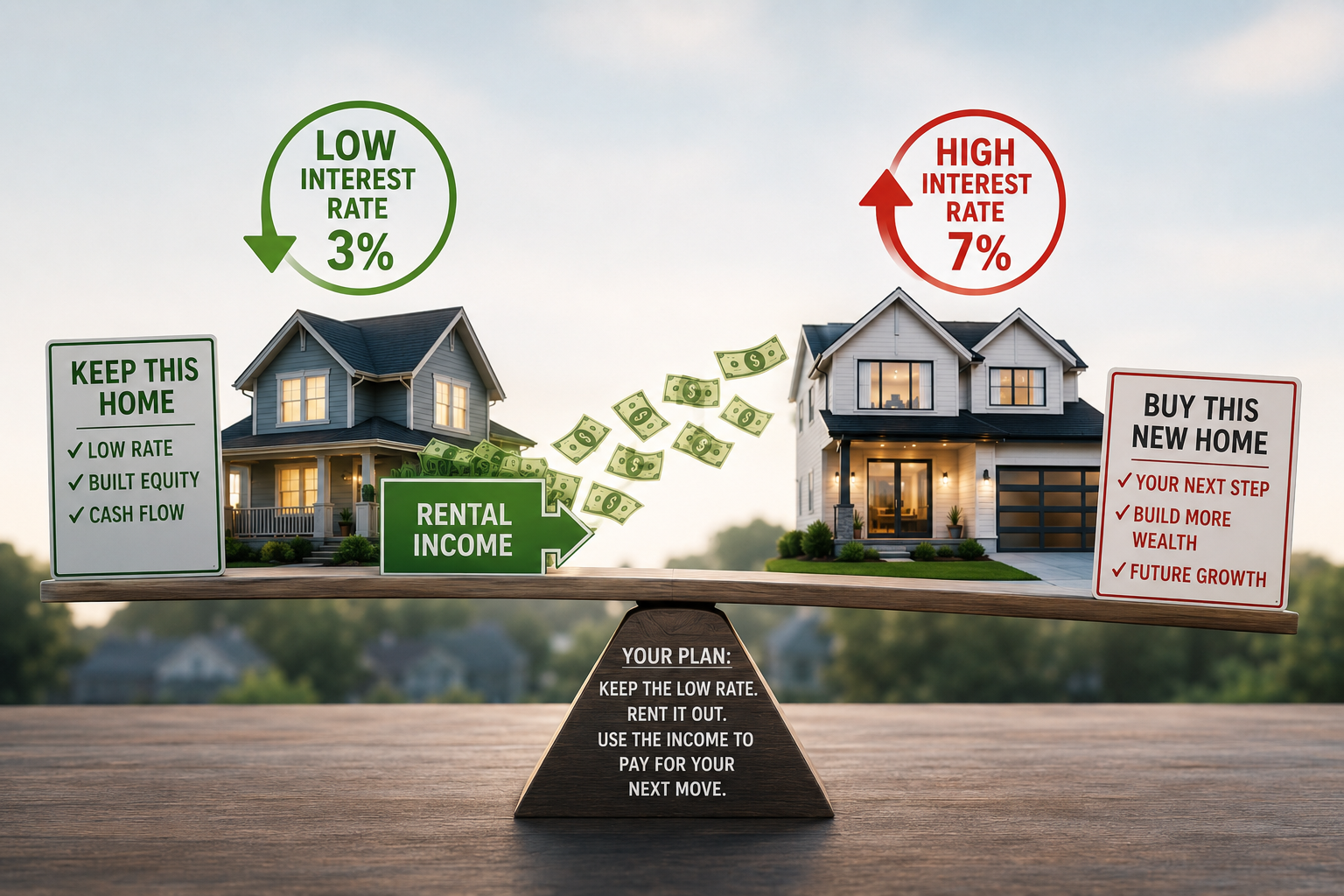
The mortgage rate on your Saratoga Springs home may be the most valuable financial asset you own right now — and you don't have to give it up to move.
Most homeowners think of selling and buying as a transaction: you sell, you buy, you trade one mortgage for another. But there's a third path that more Saratoga Springs homeowners should be seriously considering — one that lets you move into your next home while keeping your current one, preserving your low rate, generating rental income, and building equity in two properties simultaneously.
I ran the numbers on my own situation, and what I found surprised me. With rental income applied against my current mortgage, the net increase to my total housing cost wasn't thousands more per month — it was a couple hundred dollars. That's a very different conversation than the one most people are having.
This post walks through the strategy, the math, how to figure out what your home would rent for in Saratoga Springs, how to use a HELOC to fund the transition, and the capital gains timeline you need to understand before you decide how long to keep the rental.
I am not a financial advisor, tax expert, attorney, or lender. This post is for informational purposes only. Please consult a CPA, financial advisor, and your lender before making decisions about rental income, HELOCs, or tax strategy.
The Core Idea: Your Low Rate Is a Revenue Stream
If you bought or refinanced your Saratoga Springs home between 2020 and 2022, your mortgage rate is likely between 2.5% and 4%. At today's rates of 6.3%–6.5%, that rate is worth real money — not just to you as a homeowner, but to the rental market.
Here's why: rents have risen significantly alongside home prices. But your mortgage payment hasn't. If you locked in a 3% rate on a $400,000 home, your principal and interest payment is approximately $1,686 per month. Meanwhile, according to Rentler's January 2026 Saratoga Springs rental data, a 4-bedroom home in Saratoga Springs rents for $2,300–$3,000+ per month. Apartments.com currently shows the average rent for a house in Saratoga Springs at $2,410 per month.
The gap between your fixed mortgage payment and market rent is your leverage point. If your mortgage is $1,700 and the home rents for $2,200, the renter is effectively covering your mortgage and contributing $500 toward your next home's payment. Your out-of-pocket increase for moving isn't the full new mortgage payment — it's the new payment minus the rental subsidy.
That's the math I did on my own situation. With rental income applied against my current mortgage, moving into a new home costs me only a couple hundred dollars more per month than I'm paying now — not thousands. The numbers work better than most people assume before they actually run them.
The Saratoga Springs Rental Market Right Now
Before deciding whether to rent your home, you need to know what it would actually rent for. Here's what the current data shows for Saratoga Springs:
- Rentler (January 2026): Average rent in Saratoga Springs is $2,250/month across all property types; 4-bedroom homes rent for $2,300–$3,000+
- Apartments.com: Average house rent in Saratoga Springs is $2,410/month
- Zillow rental data: Average rent across all property types in Saratoga Springs is approximately $2,100/month
- Rentable.co: Average house rent approximately $2,200/month
For a typical 4-5 bedroom Saratoga Springs home with a finished basement, fenced yard, and 3-car garage, rental rates in the $2,200–$2,800 range are realistic depending on condition, location, and amenities. Homes with owned solar, RV pads, and finished basements command higher rents.
How to Find Out What Your Specific Home Would Rent For
Don't guess — research what comparable homes in your neighborhood are actually renting for. Here's the process:
1. Check Rentler Rentler.com is a Utah-based rental platform used widely by Saratoga Springs landlords. Search your home's size and area to see active listings at comparable prices.
2. Search Facebook Marketplace Facebook Marketplace is one of the most active rental listing platforms in Utah County. Search "Saratoga Springs house for rent" and filter by bedroom count to see what comparable homes are renting for right now.
3. Check Google and Apartments.com Search "[your neighborhood] Saratoga Springs house for rent" and see what active listings are priced at. Apartments.com lets you filter by bedrooms and amenities.
4. Use Rentometer for a Rental CMA Rentometer.com is essentially a CMA tool for rentals — it analyzes comparable rental listings near your address and gives you a rental range with percentile data. They offer a few free reports per month. This is the closest thing to what a property manager would use to price your home.
5. Ask Neighbors Who Are Renting If anyone in your subdivision is already renting their home, ask what they're getting. Neighborhood Facebook groups and Nextdoor are good places to find this without cold-calling strangers.
The HELOC Strategy: Using Your Equity to Fund the Move
I am not a lender. The information below is for general educational purposes only. Every homeowner's equity position, credit profile, and financial situation is different — speak with your lender directly about your specific options and what you may qualify for.
A Home Equity Line of Credit (HELOC) lets you tap into the equity you've built in your Saratoga Springs home without selling it — and use those funds as a down payment on your next home.
How it works: A HELOC is a revolving line of credit secured by your home equity. You draw from it as needed, pay it down, and draw again during the draw period (typically 10 years). Interest is only charged on what you borrow, not the full available line.
Current HELOC rates in Utah:
- Bankrate's national average HELOC rate as of May 6, 2026: 7.26%
- LendingTree: Average 7.09% on $100K HELOC in March 2026
- Bank of Utah: Introductory rate of 4.99% APR for first six months (credit score 700+), then variable
- UCCU: Introductory rate of 4.24% for 6 months, then 6.99% variable APR
Most Utah lenders allow you to borrow up to 80% of your combined loan-to-value ratio. Per SoFi's Utah HELOC guide, homeowners generally need at least 15% equity to qualify, with a credit score of 680 or higher for standard qualification and 700+ for the best rates. Speak with your lender to understand exactly what you qualify for based on your specific situation.
A practical illustration: If your Saratoga Springs home is worth $520,000 and you owe $310,000, your equity is $210,000. At 80% CLTV, you could potentially access a line of credit of up to approximately $106,000 ($520,000 × 80% = $416,000 − $310,000 owed = $106,000). That's a meaningful down payment on your next home — without selling your current one. Your actual qualifying amount depends on your lender, credit profile, and income — confirm the numbers with your lender before counting on any specific figure.
Important timing note: Most lenders require the property to be your primary residence when you open the HELOC. If you're planning to rent the home, you generally need to open the HELOC before you move out and convert it to a rental. Confirm the specific requirements and timing with your lender before proceeding.
The Math: What Does This Actually Look Like?
Let's run a realistic Saratoga Springs scenario — using illustrative numbers, not a guarantee of your outcome.
Current home:
- Mortgage payment (principal + interest): $1,750/month (3% rate, bought 2020)
- Estimated rental income: $2,300/month
- Net monthly rental surplus: +$550/month
New home:
- Purchase price: $520,000
- Down payment: $80,000 (from HELOC on current home + savings)
- New mortgage balance: $440,000
- New payment at 6.4%: approximately $2,750/month
Net total housing cost with rental subsidy: $2,750 (new mortgage) − $550 (rental surplus applied) = $2,200/month effective cost
Compare that to your current $1,750 and the real increase is $450/month — not $1,000+ that the raw mortgage comparison would suggest. Meanwhile, you now have two properties building equity, a tenant paying down your old mortgage, and a preserved 3% rate on an asset that continues to appreciate.
Your actual numbers will differ based on your specific mortgage balance, rate, home value, and local rental demand. Run your own scenario with your lender and a financial advisor before making any decisions.
What Real Homeowners Are Doing
This conversation is active in Utah real estate communities. On r/Utah and r/realestateinvesting, threads about keeping a low-rate mortgage as a rental while buying a new home are among the most engaged — and the sentiment is consistent: the people who ran the numbers and pulled the trigger are largely happy they did.
On Utah County Facebook groups for homeowners, the question "would you keep your low-rate home as a rental or sell it?" generates strong engagement. The most common response from people who have actually done it: "I wish I had done this sooner." The most common response from people who sold: "I wish I had kept it."
A thread on CougarBoard — Utah's largest community forum — captured it well: a homeowner who kept their 2020 purchase as a rental when relocating reported that the rental income covered their mortgage entirely, and they went from one home appreciating to two homes appreciating simultaneously. The consensus from experienced landlords in the thread: the hardest part isn't the math — it's finding a good tenant and being willing to be a landlord.
What to Know Before You Become a Landlord
Screen tenants carefully. A tenant who pays $200 less per month but treats the home well is worth far more than a higher-paying tenant who causes damage. Use a formal application, run credit and background checks, and verify income. Rentler and Apartments.com both offer tenant screening tools.
Budget for vacancy and maintenance. The standard landlord rule is to budget 1% of the home's value annually for maintenance, and to assume 5–10% vacancy. On a $520,000 home, that's about $5,200/year in maintenance reserves. Factor this into your break-even math.
Update your insurance. Your homeowner's insurance does not cover a rental. You'll need landlord insurance (also called a dwelling policy), which typically costs 15–20% more than standard homeowner's coverage. Update your policy before your first tenant moves in.
Consider a property manager. A property manager typically charges 8–10% of monthly rent. On a $2,300 rental, that's $184–$230/month — often worth it for the peace of mind if you're relocating or don't want day-to-day landlord responsibilities.
The Capital Gains Question: How Long Can You Rent Before the Exemption Expires?
I am not a tax expert or attorney. The following is informational only. Please consult a CPA before making any decisions about rental timelines and tax strategy.
Under IRS Section 121, you can exclude up to $250,000 (single) or $500,000 (married filing jointly) of capital gain from the sale of your primary residence — but you must have lived in the home as your primary residence for at least 2 of the last 5 years before the sale.
The practical implication: If you lived in your Saratoga Springs home for at least 2 years and then rent it out, you have approximately a 3-year rental window before you exhaust the 5-year lookback period. If you sell within that window, the Section 121 exclusion likely still applies. If you rent beyond 5 years from your move-out date without moving back in, the exclusion is generally no longer available and the full gain becomes taxable.
The depreciation recapture warning: If you rent your home and take depreciation deductions, those must be recaptured when you sell — taxed at up to 25% federally — even if your overall gain falls within the exclusion limit. I covered this in depth in my capital gains and 1031 exchange guide.
The practical landlord decision: If you plan to rent for 2–3 years then sell, Section 121 likely still applies. If you plan to hold indefinitely, a 1031 exchange may be relevant when you eventually sell. Either way — talk to a CPA before you set your timeline.
The First Step: Know What Your Home Is Worth
Before you can run the math on whether this strategy works, you need two numbers: what your home would rent for, and what it's currently worth. For the rental estimate, use the tools above. For an accurate, MLS-based market value — not a Zestimate, not the county assessor's number — I'd be happy to put that together for you personally.
Request Your Free Home Valuation →
I'll send a personalized valuation within 48 hours. From there, you can run the actual numbers with your lender and financial advisor and decide whether keeping your rate and making a move makes sense for your situation.
Related reading:
- Should You Sell If You Have a Low Mortgage Rate in Saratoga Springs?
- Capital Gains Tax vs. 1031 Exchange: What Utah Homeowners Need to Know
- Utah Property Tax Exemptions for Homeowners: The Complete 2026 Guide
- How Much Equity Do I Have in My Saratoga Springs Home?
- What Can You Get in Saratoga Springs Under $500,000 in 2026?
- New Subdivisions and Developments in Saratoga Springs 2026
Sources: Rentler — Saratoga Springs rental market, January 2026; Apartments.com — Saratoga Springs houses for rent; Zillow — Saratoga Springs rental market trends; Rentable.co — Saratoga Springs houses for rent; Bankrate — National average HELOC rate 7.26%, May 2026; LendingTree — HELOC rates March 2026; Bank of Utah — HELOC product; UCCU — Standard HELOC rates; SoFi — HELOC rates Utah; IRS — 26 U.S. Code §121; Rentometer.com.
Frequently Asked Questions
Can I keep my Saratoga Springs home and rent it out while buying a new home? Potentially yes — if you can financially qualify for both mortgages and the rental math supports the decision. Speak with your lender about your specific situation. Most lenders will consider expected rental income as part of your qualifying picture, but requirements vary by lender and loan type. Run the numbers with your lender before assuming it will work.
How do I find out what my Saratoga Springs home would rent for? Research comparable active rentals on Rentler, Apartments.com, Zillow, and Facebook Marketplace — filtering by bedroom count and proximity to your home. Then use Rentometer.com for a rental CMA — they offer a few free reports per month and provide a rental range based on comparable listings near your address.
What is a HELOC and how can it help me buy a new home without selling my current one? A HELOC (Home Equity Line of Credit) lets you borrow against the equity in your current home without selling it. You can use those funds as a down payment on your next home. I am not a lender — speak with your lender about what you qualify for based on your specific equity position, credit profile, and income. Most Utah lenders allow borrowing up to 80% of your combined loan-to-value ratio, and most require the property to be your primary residence when you open the line. Timing matters — open the HELOC before you move out.
How long can I rent my Saratoga Springs home before I lose the capital gains exclusion? Under IRS Section 121, you can generally exclude up to $250,000 (single) or $500,000 (married) of capital gain if you lived in the home as your primary residence for at least 2 of the last 5 years before selling. If you move out and rent the home, you have approximately a 3-year rental window before exhausting the 5-year lookback period — assuming you lived there for at least 2 years before moving. Beyond that, the exclusion generally no longer applies. Consult a CPA for your specific timeline — I am not a tax expert.
Does renting my home affect my ability to qualify for a new mortgage? It can help — lenders typically consider a portion of expected rental income when calculating your debt-to-income ratio. But I am not a lender, and requirements vary significantly by lender, loan type, and your individual financial profile. Speak directly with your lender about how rental income will be treated in your specific qualification scenario before counting on it.
What are the risks of keeping my home as a rental? The main risks are vacancy, maintenance costs (budget approximately 1% of home value annually), tenant damage, and the responsibilities of being a landlord. You'll also need landlord insurance rather than homeowner's insurance, and if you take depreciation deductions, those must be recaptured when you eventually sell. A property manager (typically 8–10% of monthly rent) can handle day-to-day management if needed.
