


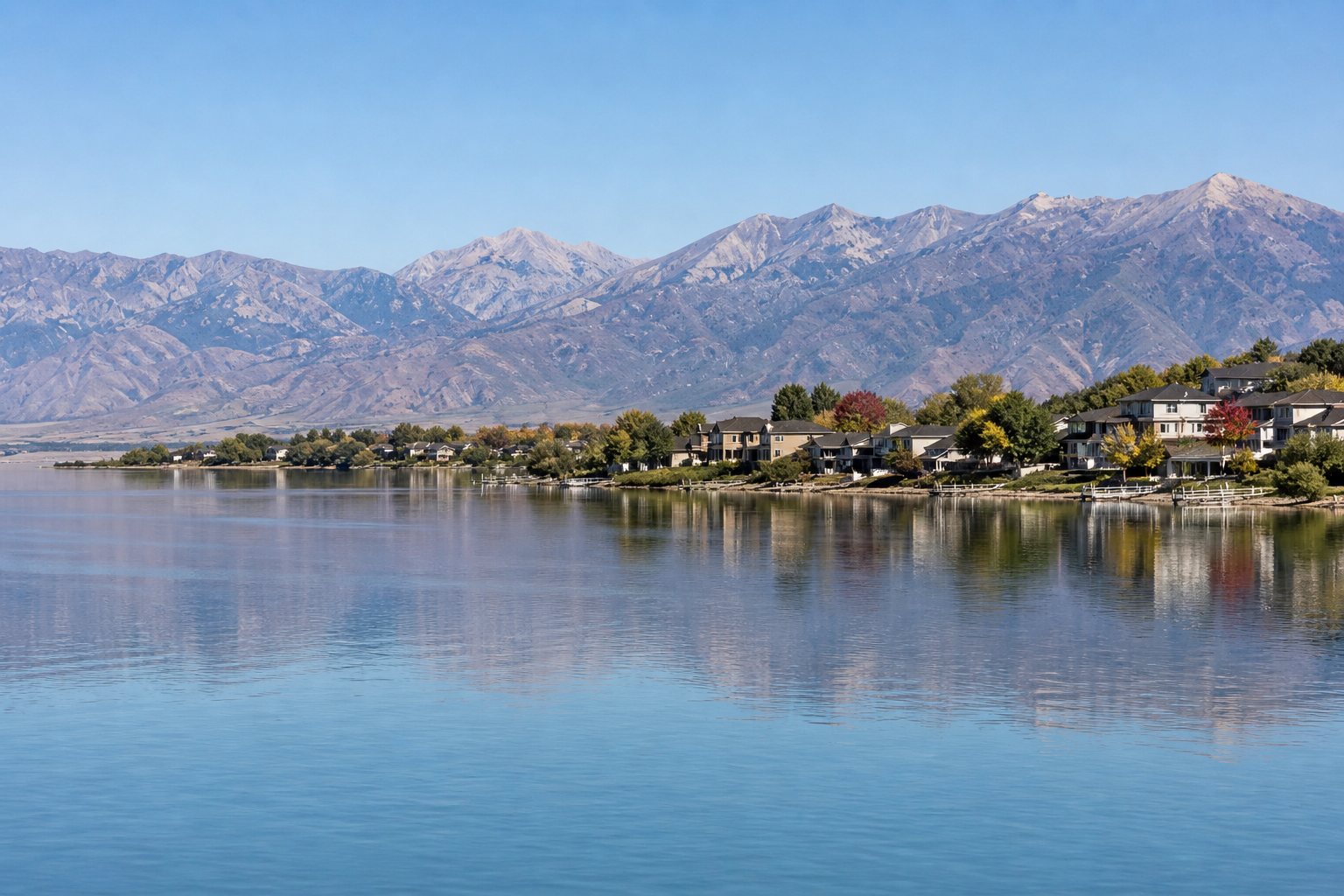
If you've ever driven down Redwood Road at sunset and caught a glimpse of Utah Lake stretching out to the west, you know how good it looks from a distance. The water, the mountains, the open sky. It's genuinely beautiful. And if you live in Saratoga Springs, that lake isn't just scenery — it's part of your neighborhood's identity, a big reason people want to live here, and increasingly, a topic that comes up in real estate conversations.
So let's talk about it honestly. What's going on with Utah Lake? Is it safe to get in the water? What's actually being done to clean it up? And what does all of this mean for people who own homes along its shores or nearby?
What Utah Lake actually is — and why it's struggled
Utah Lake is the largest freshwater lake in Utah, covering about 148 square miles at the base of the Wasatch Mountains in Utah Valley. It's shallow — averaging only about 9 feet deep — which is a big part of why it's been challenging to manage. Shallow, warm, nutrient-rich water is exactly the kind of environment where problems grow.
For decades, Utah Lake has absorbed agricultural runoff, urban stormwater, and wastewater discharge. That influx of nutrients — primarily phosphorus and nitrogen — created conditions ideal for the lake's most notorious problem: harmful algal blooms, or HABs.
These aren't technically algae at all. They're cyanobacteria — naturally occurring photosynthetic bacteria that, under the right conditions (warm water, still conditions, nutrient overload), can explode in population and produce toxins that are dangerous to humans, pets, and livestock. When a bloom happens, the lake can take on the appearance of pea soup or green paint swirled across the surface. It looks alarming, and when toxins are present, it should be taken seriously.
Is Utah Lake safe to swim in right now?
Here's the honest answer: it depends on the time of year and the current conditions, and you should check before you go — every single time.
Utah Lake does not have a blanket year-round swimming ban. The lake is open for recreation and people boat, fish, paddleboard, and walk the shoreline throughout the season. But the state actively monitors for two specific health concerns: harmful algal blooms (HABs) and waterborne pathogens like E. coli. The Utah Department of Environmental Quality maintains a live monitoring page that is updated regularly during the season (typically June through October). You can also check habs.utah.gov for real-time bloom conditions.
There are three advisory levels you'll see:
- Health Watch — evidence that a bloom may be developing or pathogens may be present. Use caution.
- Warning Advisory — a threshold has been exceeded. Strong indication a bloom or pathogen problem exists. Avoid swimming, wading, and water contact.
- Danger Advisory — severe bloom with high toxin levels. The area may be temporarily closed.
The Saratoga Springs marina is one of the sites the state monitors specifically, so you can get condition information for your neighborhood's direct access point.
The practical rule: swimming is typically safer in spring and early summer before water temperatures peak. The highest-risk window for blooms is July through September. And — importantly — even when advisories are lifted, showering after any water contact is always a good idea.
One nuance worth understanding: blooms aren't always lake-wide. The Deseret News reported last summer that a lakewide bloom was confirmed in late July 2025, but monitoring updates throughout the season showed some sites clear while others were affected. The Saratoga Springs marina had clean readings on multiple monitoring dates while other parts of the lake were under advisories. Location within the lake matters.
What about boating and fishing?
Good news here. Motorized boating and sailing remain safe even during algal bloom advisories. The Utah Lake Authority specifically notes that smaller non-motorized watercraft like kayaks and paddleboards are also generally fine, with the caveat that you should avoid activities that cause significant splashing near your face during a bloom. Wave runners and jet skis, which kick up substantial water spray, are discouraged during advisory periods.
Fishing is permitted year-round with a valid license. The recommendation is to thoroughly clean and cook any fish caught during a bloom period. The Saratoga Springs marina and the broader lakefront offer boating access that functions normally through much of the year regardless of bloom conditions.
The real progress: what's been done to fix it
Here's where the story gets genuinely encouraging — and it's a story that doesn't get told enough.
Harmful algal blooms are down 50% since 2019. That's not a projection or a goal. That's measured progress. According to the Utah Lake Authority and confirmed by KSL reporting in April 2026, the frequency and duration of harmful algal blooms has been cut in half over the past several years. Utah County Commissioner Skyler Beltran stated that "Utah Lake is now in its best condition in many years."
What's driving that improvement? Several ongoing initiatives:
Phragmites removal. Phragmites is an invasive reed that has blanketed much of Utah Lake's shoreline. It crowds out native vegetation, creates dense fuel loads that pose fire risk to adjacent neighborhoods — including parts of Saratoga Springs — and worsens water quality by disrupting natural filtration. The Utah Lake shoreline restoration project has been systematically treating the shoreline from Saratoga Springs north through Lehi, American Fork, and Lindon. According to the Daily Herald's coverage of the ULA's April 2026 "HABs Happen" campaign, 2025 saw the largest reduction of phragmites and the largest planting of native vegetation in the lake's history.
Carp removal. Invasive common carp stir up sediment from the lake bottom, releasing phosphorus that feeds algal blooms. More than 35 million pounds of carp have been removed from Utah Lake since 2009, bringing the population down to an estimated 50–75% of its original size.
Native plant restoration. The 2026 shoreline restoration project aims to restore 10 acres of native riparian and wetland vegetation in areas previously dominated by phragmites. Native plants like cattails and bulrushes help filter nutrients naturally, stabilize shorelines, and provide wildlife habitat.
HAB removal technology. The Utah Lake Authority has deployed HAB removal barges and continues to explore new intervention methods alongside traditional approaches.
The government money: a significant influx of investment
Beyond the ongoing restoration work, the past 12 months have brought a meaningful wave of public investment targeted at Utah Lake and the broader regional water ecosystem.
$7.7 million in federal funding was announced in March 2026 specifically for Utah Lake restoration, invasive species removal, and expanded public recreational access. The Lehi Free Press reported on this funding, noting that it directly supports the habitat and water quality work already underway.
Saratoga Springs North Marina expansion. A planned project funded through the Utah Watershed Restoration Initiative would add a boat launch and jetty to the north marina — directly addressing recreational infrastructure needs for Saratoga Springs residents and reducing unstructured shoreline access that has caused environmental damage. The city has also invested approximately $488,000 in dredging the existing marina to ensure access even in low water years.
State investment in water quality and conservation. The Utah Legislature has been unusually active on lake and water issues in recent sessions. While much of the political attention has gone to the Great Salt Lake, the broader ecosystem investments benefit Utah Lake as well — both lakes sit in the same regional water system, and nutrient reduction efforts in one affect the other.
The "HABs Happen" public education campaign launched in April 2026 by the Utah Lake Authority aims to shift public perception from panic to preparedness — normalizing seasonal bloom advisories the way we treat avalanche or flash flood season. The ULA's message: the lake is not closed. It needs informed visitors, not absent ones.
What this means if you own a home in Saratoga Springs
I want to be direct with you about this, because it's a question I get asked in real estate conversations regularly.
Utah Lake is an asset to Saratoga Springs — and it's becoming more of one. Waterfront and lake-view homes here already command a significant premium. True lakefront properties in Saratoga Springs list in the range of $600,000 to $1.7 million, with some luxury estates going higher. That premium exists because of the lake — the views, the access, the lifestyle. As water quality improves and recreational infrastructure expands, that story only gets stronger for buyers.
The improvement trajectory matters more than the current snapshot. Every conversation about Utah Lake that focuses only on algal bloom advisories without mentioning the 50% reduction in blooms since 2019, the $7.7 million in federal investment, or the record phragmites removal of 2025 is giving you an incomplete picture. The lake is a work in progress — but it's genuinely progressing.
For sellers near the lake, the honest framing is: don't let potential buyers be scared off by outdated or incomplete information about Utah Lake. The data on improvement is real. The investment is real. And the recreational appeal — boating, fishing, birdwatching, waterfront trails — is available right now, not dependent on the cleanup being complete.
For buyers considering Saratoga Springs, Utah Lake's trajectory is actually a reason to look at this area with more interest, not less. Neighborhoods that sit adjacent to improving natural assets tend to see long-term demand support that more landlocked communities don't have. The lake is already beautiful. It's getting cleaner. And the infrastructure around it is being built out.
How to check conditions before you go
Before heading to the lake with your family or your dog, here's exactly how to check conditions:
- deq.utah.gov/water-quality/utah-lake-recreational-monitoring — the official DEQ monitoring page, updated during the season (June–October). Includes site-specific readings for the Saratoga Springs marina.
- habs.utah.gov — interactive map showing current bloom conditions statewide.
- utahlake.gov — the Utah Lake Authority's site with bloom information, project updates, and recreation guidance.
The monitoring season resumes in June or July 2026. Until then, the ULA advises using caution and knowing what to look for: discoloration, scum, or a paint-like sheen on the water surface are all signs to stay out.
When in doubt, stay out. When conditions are clear — and they often are, especially earlier in the season and at the Saratoga Springs marina — there's a lot to enjoy right in your backyard.