


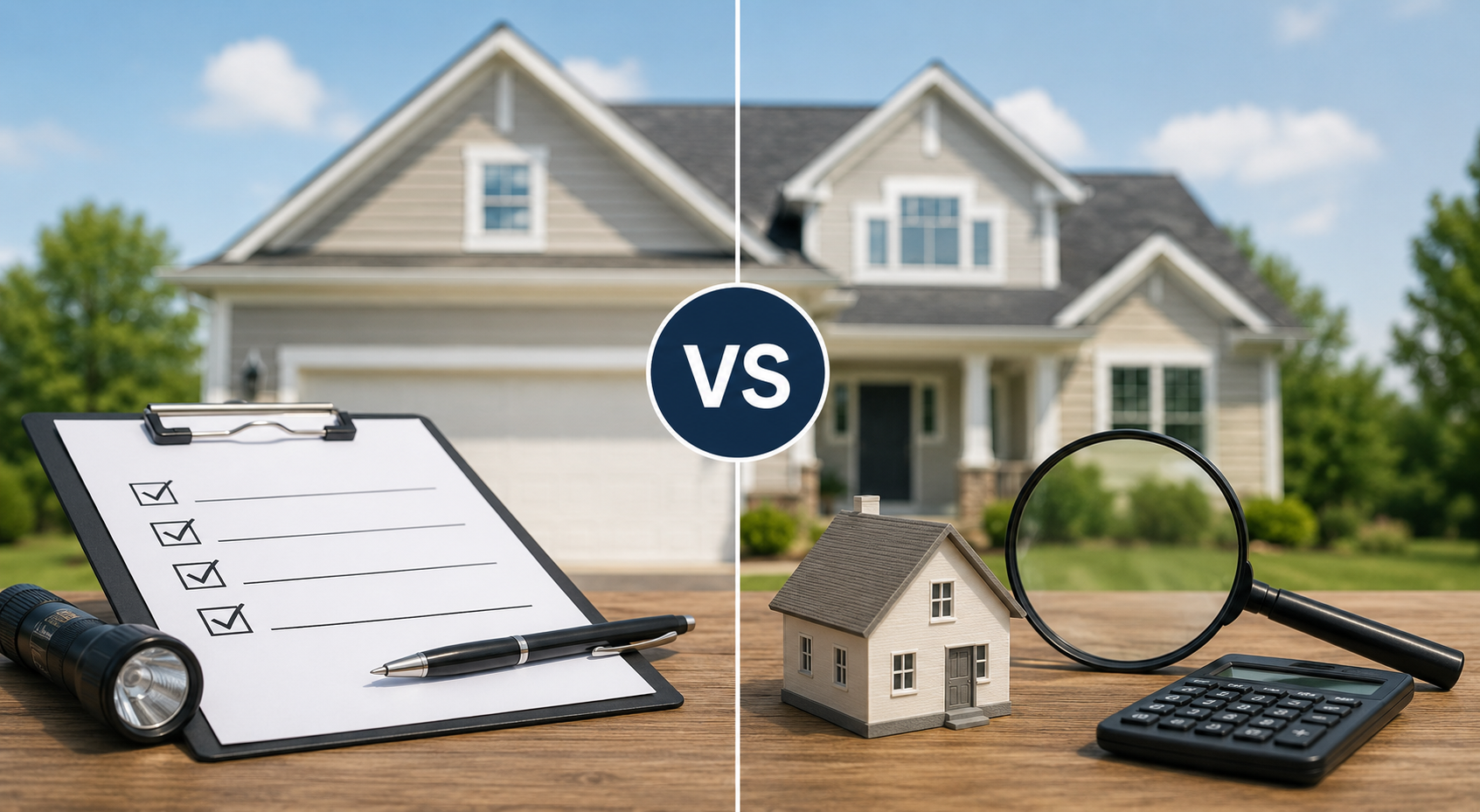
If you're buying your first home, "inspection" and "appraisal" can sound like two people coming to the house to do basically the same thing.
They aren't. They serve completely different purposes, and knowing the difference can save you from an expensive misunderstanding.
Here's the simplest version:
A home inspection tells you about the condition of the home.
A home appraisal helps determine the value of the home.
You may need both when you buy, but they protect different interests and answer different questions. This guide is about telling them apart. If you want the step-by-step of how the appraisal process itself works, I cover that separately in how does a home appraisal work in Utah County, so here I'll stay focused on how an appraisal differs from an inspection.
The quick answer
| Home Inspection | Home Appraisal | |
|---|---|---|
| Main purpose | Evaluate the home's condition | Estimate the home's value |
| Mainly for | The buyer | The lender |
| Who performs it | Home inspector | Appraiser |
| Looks for defects? | Yes, within the inspection's scope | Only as relevant to the loan |
| Determines market value? | No | Yes |
| Usually required by lender? | Generally no | Often yes when financing |
| Can affect negotiations? | Yes | Yes |
| Does one replace the other? | No | No |
The Consumer Financial Protection Bureau puts it plainly: a home inspection is different from an appraisal, and buyers using financing will generally need some form of appraisal even if they also have the home inspected.
What is a home inspection?
A home inspection is an evaluation of the physical condition of the property. You hire an inspector to look for defects, safety concerns, and things that may need repair or a closer look.
Depending on the home and the scope, an inspector may evaluate the roof, foundation, electrical, plumbing, HVAC, attic, insulation, windows and doors, appliances, the water heater, exterior drainage, visible structural concerns, and signs of moisture or water intrusion.
The inspection gives you a much better understanding of what you're actually buying. And I strongly recommend attending yours if you can. A written report is useful, but walking the home with the inspector lets you ask questions, see issues firsthand, and understand which findings are significant versus normal maintenance.
What if the inspector finds problems?
First, don't panic. I have yet to see a perfectly clean inspection report. Even brand-new homes have findings.
The question isn't "did the inspector find anything." It's "what did they find, how serious is it, and what do we want to do about it?"
Depending on your contract and where you are in your due diligence period, you may decide the issue is minor and move forward, ask the seller to make repairs, negotiate a credit, bring in a specialist like a roofer or structural engineer for a closer look, or decide the problem is significant enough that you no longer want the home. Your exact options depend on your purchase contract and timing, which is why the inspection should be scheduled promptly.
What is a home appraisal?
An appraisal answers a different question: what is this property worth?
It's an independent professional opinion of value. When you're financing, the lender wants to know whether the property is adequate collateral for the amount they're lending you. To form that opinion, an appraiser weighs things like recent comparable sales, location, size, and condition. I walk through exactly how they do that in how a home appraisal works. For our purposes here, what matters is the question it answers: value, not condition.
Here's how it plays out. You agree to buy a home for $550,000. The lender orders an appraisal. If it comes back at $550,000, the value supports the price and, assuming the rest of the loan checks out, there's no valuation problem. If it comes back at $525,000, now there's something to work through. I wrote a full guide on that in what to do if a home appraises below the purchase price.
Does an appraiser inspect the house?
An appraiser may visit and observe the property, and condition can matter to the appraisal. Depending on the loan program, the appraiser may also need to note certain readily observable conditions.
But that doesn't make an appraisal a home inspection. HUD specifically warns FHA buyers that an appraisal does not replace a home inspection. An appraiser isn't doing the detailed evaluation of the home's systems that your inspector does.
Think of it this way. Your inspector is asking: what's wrong with this house, and what should my buyer know? Your appraiser is asking: what is this property worth for this loan? Two different jobs.
But doesn't an FHA appraisal include an inspection?
Sort of, and this is where the terminology trips people up. An FHA appraisal includes observations related to FHA's property requirements, and an FHA appraiser may flag readily observable conditions that could affect the home's eligibility for FHA financing.
That still does not replace an independent home inspection. HUD states that an FHA appraiser's observation is limited to readily observable conditions and isn't as comprehensive as a home inspection. So please don't think "I'm getting an FHA appraisal, so I don't need an inspection." They're two different things.
Can a house pass an appraisal and still have serious problems?
Yes. This is probably the most important takeaway in the whole article.
An acceptable appraisal does not mean the home is problem-free. The appraisal isn't a warranty. It doesn't mean the roof has 15 years left, the HVAC is in great shape, there's no moisture intrusion, or the sewer line is fine. And it doesn't mean you won't have expensive repairs after closing. That's why I don't want buyers leaning on an appraisal to tell them whether a home is in good condition.
Can a home inspection affect the appraisal?
They're separate processes, but they can intersect. An inspection could uncover a significant issue that affects the transaction, and certain property conditions can affect an appraisal or a lender's willingness to finance. The CFPB notes that if an appraisal identifies major repairs, or if a loan program requires certain property standards, the lender may require repairs before closing.
But your inspector isn't determining the appraised value, and your appraiser isn't replacing your inspector.
Who orders each one?
The inspection: usually the buyer chooses and hires the inspector. I recommend someone thorough who will explain what they're seeing rather than hand you a giant report and disappear. The CFPB recommends hiring an independent inspector who is accountable to the buyer, and scheduling as soon as possible after going under contract. Your agent can usually share names of inspectors buyers have had good experiences with, but the choice should be yours.
The appraisal: when you're getting a mortgage, the lender generally orders it. You shouldn't be shopping for an appraiser to produce the value you want, because appraiser independence is a core part of the mortgage process. Your lender is also generally required to give you a copy of the appraisal it obtains for a first-lien mortgage.
Do cash buyers need an appraisal?
Not necessarily. Without a mortgage lender requiring one, there's no loan to support. But a cash buyer can still choose to get an appraisal for extra information about value. A home inspection is a separate decision, and personally, paying cash wouldn't make me any less interested in understanding a home's condition before buying it.
Do new construction homes need an inspection?
I recommend them. The biggest misconception I hear is "it's brand new, what could be wrong?" Plenty.
New doesn't mean perfect. Construction involves dozens of subcontractors and thousands of components, and things get missed. I've seen new-construction findings involving insulation, roofing, electrical, plumbing, HVAC, drainage, appliances, and windows. That doesn't mean the builder did a bad job. It means another set of qualified eyes has value. I wrote more in new construction home inspections in Utah County.
What about radon, meth, sewer scopes, and other tests?
A standard inspection isn't always the end of your due diligence. Depending on the property's age, location, and your concerns, you may want additional testing: radon, meth, a sewer scope, a septic inspection, a mold or structural evaluation, and so on. Not every property needs every test. The point of due diligence is to investigate what's relevant to that particular property so you can make an informed decision.
Which one protects the buyer?
I wouldn't think of it as choosing between them. They protect against different risks. The inspection helps you understand what you're buying. The appraisal helps establish what the property is worth for the loan. If you're borrowing to buy, you'll often see both.
The mistake is assuming that because an appraiser visited the house, someone already inspected it. They didn't.
The bottom line
If you remember nothing else: inspection is condition, appraisal is value. They aren't interchangeable.
Your inspection helps you understand the home's physical condition and catch problems before you own them. Your appraisal helps your lender determine the property's value for the mortgage. Both can surface information that changes a deal, but they're doing completely different jobs.
You don't need to understand all of this before you start looking. That's what your agent is for.
Frequently asked questions
Is a home inspection the same as an appraisal?
No. A home inspection evaluates the physical condition of a property. An appraisal provides an opinion of its value. An appraisal does not replace a home inspection.
Do I need both when buying a house?
If you're financing, your lender will generally require some form of appraisal. A home inspection is usually something the buyer chooses to get for their own protection. Whether either is required in a given deal depends on the loan, contract, and circumstances.
Does an appraisal tell me if the house is in good condition?
No. An appraiser may observe condition, and certain issues can affect value or loan eligibility, but an appraisal isn't a comprehensive evaluation of the home's systems. That's what a home inspection is for.
Can a home pass inspection but come in low on appraisal?
Yes. They evaluate different things. An inspector could find few concerns while the appraiser finds the price isn't supported by comparable sales. The reverse happens too: the home appraises at the price while the inspection uncovers expensive problems.
What happens if the appraisal comes in lower than my offer?
Your options depend on your contract, and can include negotiating with the seller, requesting reconsideration of the appraisal when appropriate, bringing extra cash to closing, restructuring, or terminating under your contract's rights. Full guide: what to do when a home appraises below the purchase price.
Can I negotiate repairs after a home inspection?
Often, depending on your contract and deadlines. Buyers may request repairs, negotiate credits, accept the home as-is, investigate further, or exercise cancellation rights. What applies to you depends on your purchase contract.
Does an FHA appraisal replace a home inspection?
No. HUD specifically tells FHA buyers that an appraisal does not replace a home inspection. FHA appraisers note certain readily apparent conditions, but their review isn't as comprehensive as an independent inspection.
Should I get an inspection on a brand-new home?
I recommend it. New homes can still have construction defects, installation mistakes, and unfinished items. An independent inspection gives you another set of eyes before closing.
Related reading
- How does a home appraisal work in Utah County?
- What to do when a home appraises below the purchase price
- New construction home inspections in Utah County
- Radon in Utah County homes
- Meth contamination in Utah homes
- How to buy your first home in Utah County
This article is for general informational purposes only and is not legal, lending, inspection, or appraisal advice. Inspection rights, due diligence deadlines, appraisal provisions, and cancellation rights depend on the terms of your purchase contract, and loan requirements vary by lender and program. Consult the appropriate licensed professional for guidance specific to your situation.
A CMA is not an appraisal and should not be used as one. A formal appraisal can only be performed by a licensed appraiser.
Sources: CFPB, Schedule a Home Inspection. CFPB, What Are Appraisals and Why Do I Need to Look at Them? CFPB, Why Did I Receive Different Valuations? U.S. Department of Housing and Urban Development, FHA Appraisers.