


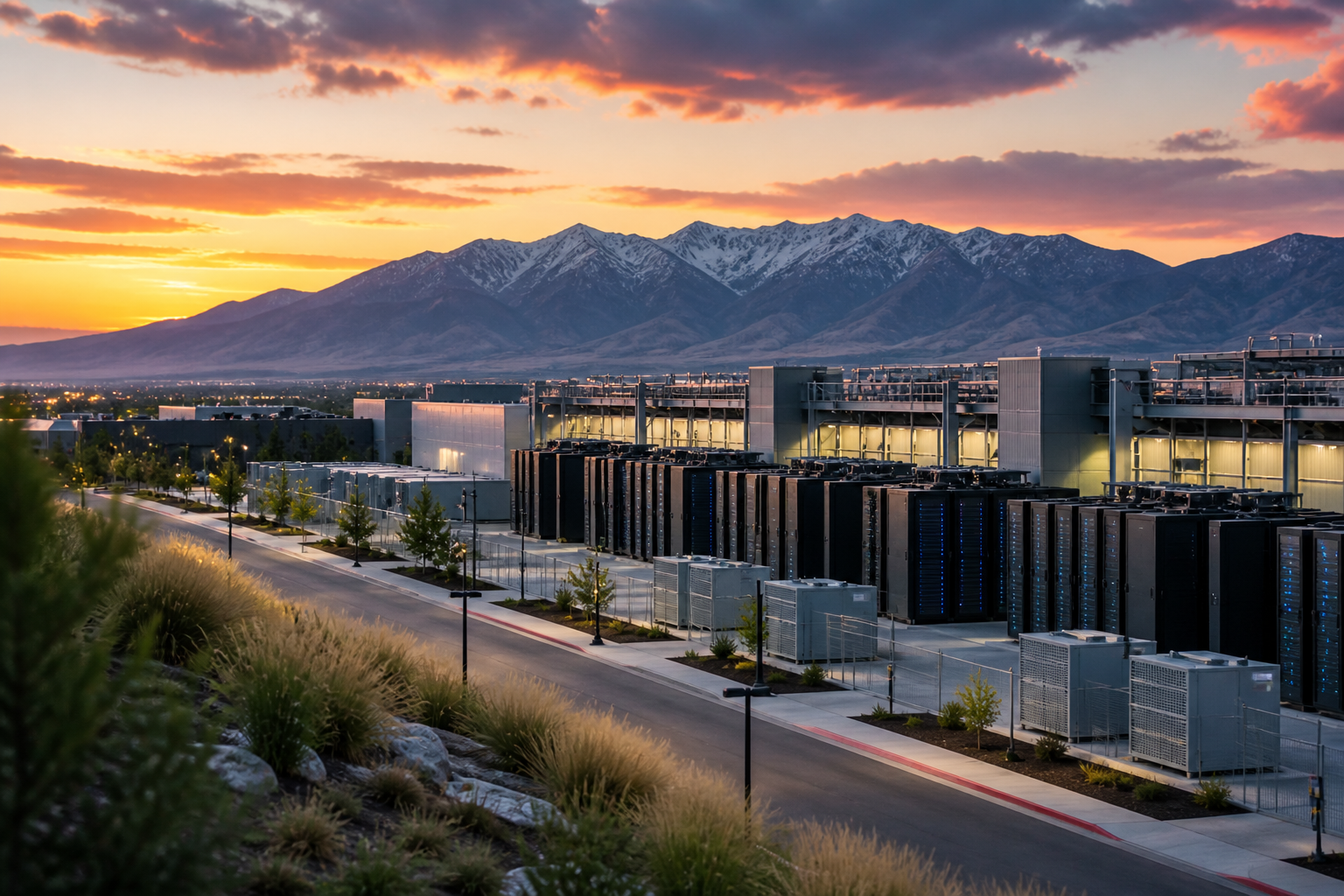
You may have seen the headlines this week. A massive hyperscale data center project — backed by "Shark Tank" investor Kevin O'Leary and his company O'Leary Digital — just received approval from Utah's Military Installation Development Authority. The Salt Lake Tribune broke the story, and the numbers are genuinely staggering: the proposed "Stratos" project in rural Box Elder County would span 40,000 acres and ultimately consume up to 9 gigawatts of power — more than double what the entire state of Utah currently uses.
It's a big deal. And it's not happening in a vacuum. Utah already has 48 operational data centers drawing nearly 920 megawatts of power, with another 2,600 megawatts under construction. The biggest single facility in the state is the NSA's 1.5-million-square-foot data center at Camp Williams near Saratoga Springs — right here in our backyard. Data centers are not new to Utah County. What's changed is the scale and the pace, and it's worth understanding what that means for people who own homes here.
So what does any of this mean for those of us living in Utah County? Let me give you an honest look at both sides.
Why people are upset about data centers
The opposition to the Stratos project has been vocal. More than 80 residents packed a Box Elder County commission meeting carrying signs that read "People before profits" and "Where's the research." The county commission ultimately delayed the final vote, with commissioners saying they felt blindsided by how fast the project moved and how little public input was allowed.
The concerns residents are raising are real and worth taking seriously:
- Power consumption. A 9-gigawatt facility is an almost incomprehensible amount of energy. Critics argue that even if the Stratos project generates its own power off-grid through a natural gas pipeline connection, the broader data center boom is already putting upward pressure on energy costs for everyone. Goldman Sachs analysts estimated that increased data center demand contributed to electricity bills rising roughly 7% as of late 2025 — costs that hit lower-income households hardest.
- Water. Data centers require enormous amounts of water for cooling. The NSA's facility near Saratoga Springs reportedly uses tens of millions of gallons per month during summer — while a typical Utah household uses around 163,000 gallons in an entire year. In a state that's been in a prolonged drought cycle, that's not an abstract concern.
- Transparency and speed. The speed at which the Stratos deal moved through state approval — with massive tax concessions negotiated largely out of public view — is a legitimate grievance. Residents and even some county commissioners felt excluded from a decision that will fundamentally reshape their community.
- Tax giveaways. To attract hyperscale tenants like Amazon, Microsoft, and Google, Utah's MIDA agreed to slash the standard 6% energy use tax down to 0.5% and rebate 80% of property tax revenue back to O'Leary Digital. Supporters argue the remaining revenue still generates $30 million a year for Box Elder County in the first phase. Critics ask whether residents are getting a fair share of the upside.
- Noise and quality of life. Near existing data center sites, neighbors have reported the constant hum of cooling fans and generators. One rural Utah resident near a planned data center site described what it would feel like to have natural gas generators running nearby: the equivalent of more than 400 semi-trucks idling around the clock.
A new concern worth knowing about: the heat island effect
Recent research has added another item to the list. A study released in early 2026 by an international group of researchers from Cambridge, Singapore, and Hong Kong found that large data centers may be creating localized "heat islands" — raising surface temperatures within roughly a six-mile radius of a facility. The study, which has not yet been peer-reviewed, found that ambient surface temperatures increased by an average of about 3.6 degrees Fahrenheit after a data center opened, with some locations seeing spikes as high as 16 degrees.
The research has drawn pushback from some scientists who argue that much of the observed warming is due to the construction of large buildings, pavement, and infrastructure around data centers rather than heat from the facilities themselves — and that the effect on actual air temperature in surrounding neighborhoods may be far smaller than the satellite-measured surface temperature data suggests.
Still, for Utah County communities that already experience hot summers, any additional localized heat in or near residential areas is a conversation worth having. As more data center projects come to the Wasatch Front, it's a fair question for community leaders to be asking developers.
Why data centers can be good for a community
Here's the other side of the ledger, and it's also real.
Jobs. The data center pipeline expected to come online in Utah by 2030 is projected to create between 2,000 and 3,250 permanent operations jobs in the state, according to the University of Utah's Kem C. Gardner Policy Institute. The Stratos project alone projects 2,000 permanent jobs in Box Elder County after construction. These aren't just tech jobs — the industry needs electricians, HVAC technicians, construction workers, and security personnel.
Tax revenue. In communities that have successfully hosted data centers, the property tax impact has been significant. In Loudoun County, Virginia, data centers now account for nearly half of all property tax revenue — directly funding schools and reducing tax rates for homeowners. In Utah County, that model could mean better-funded schools and improved infrastructure in communities near these facilities. One Utah County commissioner has called data centers a "net positive property tax revenue driver for communities."
Economic multiplier effect. Data centers don't arrive alone. They attract complementary businesses, suppliers, and workers. For an area like Utah County — already growing rapidly along Silicon Slopes — that kind of economic activity supports the commercial development, services, and amenities that make communities more livable and keep housing demand strong.
Off-grid power. One of the more compelling aspects of the Stratos project specifically is that it will generate its own power off the public grid through a connection to the Ruby Pipeline natural gas line. If that holds, it meaningfully reduces concerns about data center growth straining the electricity supply that Utah County homes and businesses depend on.
National security. Kevin O'Leary framed the project in terms of global competition: "China built 400 gigawatts of new power over the last 24 months, and much of it is powering AI data centers. We're in a race with them." That framing resonates with a lot of Utahns — and it's not wrong. Keeping American data on American infrastructure, built with American workers, is a legitimate consideration that goes beyond economics.
What it means if you own a home in Utah County
Utah County and the broader Wasatch Front already have a meaningful data center footprint — and it's going to grow. Utah is on track to more than triple its data center capacity in the next few years, with growth concentrated heavily along the I-15 corridor and the Silicon Slopes tech ecosystem that Utah County anchors.
For homeowners, here's my honest read:
The economic activity that data centers bring — jobs, tax revenue, commercial development — generally supports housing demand and property values. Communities with strong employment bases and well-funded schools tend to hold their value over time. That's a net positive for homeowners across the county.
The legitimate concerns around water, energy costs, noise, and now the emerging research on localized heat are real — but most of the direct impacts are felt closest to the actual facilities. The largest new projects are being sited in rural areas specifically because of land and power availability, not proximity to existing neighborhoods.
What I'd watch closely: whether Utah County communities are given a real voice as more of these projects move through approval. The frustration in Box Elder County wasn't really about data centers — it was about feeling like the community's voice didn't matter until residents showed up with signs. That's worth paying attention to regardless of how you feel about the underlying projects.
"The question isn't really whether Utah will have data centers. It already does — and more are coming. The question is whether communities get to shape how that growth happens."
Utah County is already playing a significant role in the national AI infrastructure buildout whether we asked for it or not. The NSA put us on the map. Silicon Slopes grew the reputation. Understanding what's driving these decisions — and what the real tradeoffs are — puts you in a better position to follow the story as it continues to develop right here at home.