


Written by Kat Ashby, Principal Broker and Realtor® at RootQuest Realty LLC in Saratoga Springs, Utah. Kat holds a Utah Division of Real Estate Principal Broker license (Credential #10382396-PB00) — a designation that requires demonstrated experience, additional coursework, and a separate licensing exam beyond the standard agent license. She has been actively selling in Utah County since 2020, with deep experience across Lehi, Eagle Mountain, Saratoga Springs, and the broader Wasatch Front, specializing in buyer representation, new construction, and corporate relocation through Altair Global. She is fluent in English and Portuguese, earned her bachelor's degree in Psychology from Brigham Young University, and lives in the community she sells in.
Kat Ashby complies with all fair housing laws and does not steer clients toward or away from any neighborhood based on religion, national origin, or any other protected class. This post is intended to help newcomers understand the community they are moving into — not to influence where anyone should or should not live.
Moving to Utah County is the question I get asked about more than almost any other. Not about home prices, not about commutes, not about schools. The culture question. Because people can research everything else on Zillow and Google Maps, but they can't look up how it actually feels to be a newcomer in a community with a social fabric they've never navigated before.
So let's talk about it honestly.
Full disclosure: I'm a member of The Church of Jesus Christ of Latter-day Saints. That means my perspective comes with built-in bias, and I want to be upfront about that.
But here's what makes my perspective a little different. I grew up in Brazil — not Utah. My childhood friends were Catholic, Presbyterian, and non-Christian, and we all grew up together without it being a big deal. I came to the United States between ages 4 and 6, came back as an exchange student, and then again in 2008 for college — where I met my husband and ended up making Utah home.
What struck me when I arrived in Utah was that even the LDS community here felt different from what I knew in Brazil. Same faith, different culture. That taught me something important: religion and culture are not the same thing. Every community has its own rhythms, even within the same belief system. Utah LDS culture is its own thing — with real strengths and real peculiarities — just like every culture everywhere.
So when I write about what it's like to move here as a newcomer from outside this cultural context, I'm doing my best to see it from the outside even though I'm on the inside. I don't think I can do that perfectly. But I think my background gives me a slightly better shot at it than someone who has never known anything different.
What I can say with confidence is that I have watched people from every background — every faith, every nationality, every walk of life — build wonderful lives here. I'm one of them.
The Numbers First
According to the Pew Research Center's 2023–24 Religious Landscape Study, 50% of Utah adults identify as members of The Church of Jesus Christ of Latter-day Saints, down from 58% in 2007. That's the most current, nationally rigorous data available.
It also means 50% of Utah adults are not LDS. Utah is not a monolith.
That said, Utah County specifically has a higher LDS concentration than the state average. According to the Kem C. Gardner Policy Institute's 2024 analysis, 89% of Utah County residents adhere to a religion, with the LDS church by far the largest. Salt Lake County sits at 67.4%. If you're moving to Eagle Mountain, Saratoga Springs, Lehi, or Provo, you are likely moving into a community where most of your immediate neighbors are LDS. That doesn't mean you won't belong. It means the social dynamics work a little differently — and understanding why makes all the difference.
Why the Social Structure Feels Different — and Why It Makes Sense
Here's the thing that I think helps people the most, and that a lot of relocation guides miss entirely.
Think about your closest friends from the last few years. Chances are they're people you see regularly — gym friends, work friends, neighbors you run into at the mailbox. Proximity and shared experience are the foundations of most friendships.
Now imagine your faith community organized social events multiple times a week, every week, for your entire life. Sunday services, mid-week activities, youth camps, service projects, neighborhood "ward" gatherings — all built around the same geographic boundaries as your actual neighborhood. LDS members don't just share beliefs. They share a schedule. They see each other constantly. That kind of repeated contact builds deep bonds naturally.
When you move into that community from outside that structure, you haven't had that shared history. The bonds that feel automatic to your LDS neighbors took years to build. That's not exclusion — it's the natural result of how community forms when people spend a lot of time together. I know this from the inside. I also know that good people don't always realize how their closeness with each other can look like a wall to someone on the outside.
One woman who moved to Utah County wrote about her experience: the LDS neighbors were friendly and welcoming, but close friendships took longer to develop than she expected. Looking back, she realized it was her expectation — not their intention — that needed adjusting. She now has what she calls lifelong friendships in her neighborhood. That story is the one I hear most often from clients who make the transition successfully.
What You'll Actually Notice Day to Day
Sundays are quieter. Many locally-owned businesses close on Sundays. National chains and restaurants are generally open, but Sunday in Utah County has a different rhythm than most American cities. Some newcomers love it. Some find it an adjustment.
Alcohol is different. Utah has a state-controlled liquor system. Restaurants require specific licenses to serve alcohol. State-run liquor stores operate on limited hours. You can get a drink in Utah County, but it's not as seamless as in most states. This surprises people from virtually everywhere.
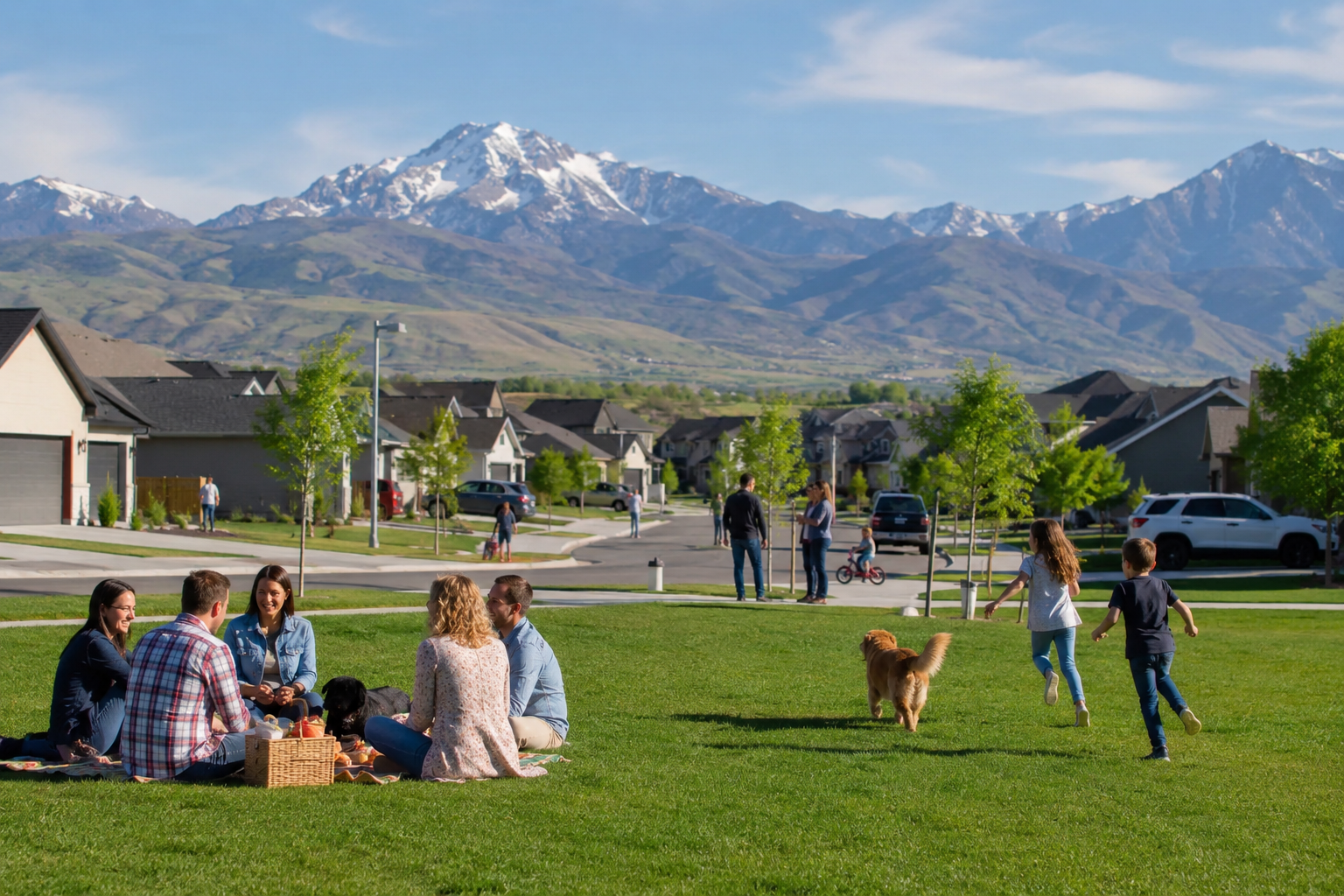
Families are everywhere. Utah has the highest birth rate in the country. Neighborhoods here are genuinely full of kids playing outside, at parks, in the streets. For families with young children, this is one of the best things about living here.
People will be kind to you. This gets lost in the online anxiety around this topic. The most common experience from newcomers I've worked with isn't hostility — it's genuine warmth from LDS neighbors, even before any real friendship develops. Helping with a move. Bringing food when someone is sick. Waving from the driveway. These are real and consistent.
You may be invited to church. Most of the time, a polite decline ends it there. But I want to be honest: some LDS members do struggle with boundaries. If someone makes you uncomfortable, it's completely okay to be clear and direct about it. You don't need to be rude, but you don't need to tolerate it either.
Not every LDS neighbor will be warm and welcoming. I wish I could say otherwise, but that wouldn't be true. Just like any gym, workplace, or community you've ever been part of, you will encounter people who are cliquey or just not interested in getting to know you. That's not unique to Utah County — but the density of the social network here can make it feel more pronounced when it happens. If you've had a genuinely bad experience, your experience is real and deserves to be respected, not explained away.
What LDS Members Actually Believe
Since this post is for people who may have little familiarity with the LDS faith, I want to point you to good information rather than leaving you to navigate the internet's very wide range of opinions.
The most accurate source is the church itself:
- Official church website: churchofjesuschrist.org
- Beliefs and practices in their own words: newsroom.churchofjesuschrist.org
- Core beliefs and Gospel topics: churchofjesuschrist.org/study/manual/gospel-topics
At its core, The Church of Jesus Christ of Latter-day Saints is a Christian faith. Members believe in Jesus Christ as their Savior, study the Bible alongside the Book of Mormon, and organize their lives around principles of family, service, and community. Going directly to the church's own materials is the most honest starting point.
The Honest Challenges
I want to be real here, because this is a guide for people making a real decision.
Building close friendships takes longer. Almost every newcomer to Utah County says this. Not because neighbors are unkind, but because the existing social infrastructure is so dense that making your way into it takes time and intentionality. Plan for a year of building, not a month.
Social events often center around the church. Ward parties, neighborhood gatherings, service projects — a lot of Utah County's informal social life flows through LDS organizational structures. As someone outside that structure, you're adjacent to it rather than inside it.
Your kids may feel different at school. In communities with high LDS concentration, some kids from outside that tradition describe feeling like outsiders, particularly in middle school. It's worth talking to your kids about the landscape before you move — not to create anxiety, but to give them tools.
Some experiences here are genuinely hard. If you search Reddit threads about moving to Utah, you'll find a wide range of accounts — some very positive, some genuinely painful. I believe most LDS members try to be good neighbors. I also believe that good intentions don't always land the way they're meant to, and that some people have had real experiences of feeling excluded. Both things can be true at the same time.
Read Real Experiences From People Who've Made This Move
The internet has no shortage of honest voices on this topic. Here are some worth reading:
Reddit communities:
- r/Utah — broad community discussions about life in Utah
- r/SaltLakeCity — frequently has threads about religious culture and newcomer experiences
- r/exmormon — voices from people who have left the LDS faith and continue to live in Utah; one perspective among many
Forums and longer-form discussions:
- City-Data Utah forums — some of the longest-running, most detailed threads about newcomer life in Utah, with hundreds of first-hand accounts
- Salt Lake Tribune — in-depth reporting on how the LDS/non-LDS dynamic plays out in neighborhoods, schools, and workplaces
What Actually Works
Here's what I've watched make the transition successful — from clients who've moved here from Georgia, New York, Texas, North Carolina, France, Italy, and Brazil.
Come in curious, not guarded. People can tell the difference. Genuine interest in understanding a culture you're unfamiliar with opens doors that defensiveness keeps closed. I've navigated enough cultural transitions in my own life to know this is true.
Get involved in something with a regular schedule. A gym, a rec sports league, a hiking club, a neighborhood pool, a volunteer organization. The social structure that works so well for LDS members works because of repeated contact. Create your own version of that.
Give it time. Every person I've spoken to who thrived in Utah County said the same thing: the first year was an adjustment, and then it became home. Not despite the LDS community, but often because of the genuine kindness within it.
Know that you are not alone. According to Pew Research, 34% of Utah adults identify as religiously unaffiliated — actually higher than the national average of 29%. And even within Utah County, there are more people from outside the LDS tradition than most newcomers expect.
Use resources designed for newcomers. Meetup.com has active groups throughout Utah County for hiking, social events, and dozens of other interests. Eagle Mountain and Saratoga Springs Facebook groups are active and genuinely useful for new residents. Many cities have community events and newcomer programs not affiliated with any religious organization.
Know your own boundaries and enforce them. If a neighbor is pushing too hard on the religious front and it's making you uncomfortable, it's okay to be clear and direct. You don't owe anyone your patience beyond what you're genuinely willing to give.
The Bottom Line
Utah County has a distinct culture. That's not a warning — it's just true, and it's worth understanding before you arrive rather than after.
Most people who move here with open eyes, realistic expectations, and a willingness to invest in community end up genuinely loving it. The outdoor access is remarkable. The community infrastructure for families is real. The people are, on balance, genuinely kind.
The adjustment is real too. The social structure is different from most American cities. The first year requires more intentionality than you might expect. And some experiences are genuinely hard.
But I've watched people from every background, every faith, and every corner of the world build wonderful lives here. If you go in prepared — with honest expectations and a plan for building community on your own terms — Utah County can absolutely be home.
Questions About Moving to Utah County? Let's Chat →
Related Articles
- Is Utah County a Good Place to Live? An Honest Local's Guide for 2026
- Utah County vs. Salt Lake County: An Honest Comparison for People Moving to the Wasatch Front
- Moving to Utah County or Salt Lake County in 2026?
- The Complete Moving to a New State Checklist (2026)
- What Can You Get in Eagle Mountain Under $500,000 in 2026?
- What Can You Get in Saratoga Springs Under $500,000 in 2026?
Sources: Pew Research Center — Religious Landscape Study 2023–24, February 2025 — 50% of Utah adults LDS, 34% religiously unaffiliated; Kem C. Gardner Policy Institute — Religious Affiliation in Utah, 2024 — 89% of Utah County residents adhere to a religion, Salt Lake County 67.4%.
Frequently Asked Questions
What is it like to move to Utah County as a non-LDS resident? Most newcomers describe an initial adjustment period — close friendships take longer to form than expected because the existing social infrastructure is deeply rooted in LDS community life. Most also report that the community is genuinely kind and welcoming, and that after about a year, Utah County begins to feel like home. Coming in with realistic expectations and a plan for building your own social network makes a significant difference.
Is Utah County welcoming to people of all backgrounds? In general, yes. Utah County communities are family-oriented and neighborly. Most newcomers from all backgrounds report experiencing genuine kindness from their LDS neighbors. The cultural adjustment is real, but hostility is not the typical experience. Your background, faith, or origin does not determine your ability to build a wonderful life here.
How LDS is Utah County specifically? According to the Kem C. Gardner Policy Institute's 2024 analysis, 89% of Utah County residents adhere to a religion, with the LDS church by far the largest. This is higher than the state average — statewide, 50% of Utah adults identify as LDS per Pew Research 2023–24.
How do I build community in Utah County as a newcomer? Get involved in something with a regular schedule — a gym, rec sports league, hiking club, or volunteer organization. Repeated contact is how friendships form here, just as it is everywhere. Meetup.com has active Utah County groups. City Facebook groups for Eagle Mountain, Saratoga Springs, and Lehi are active and useful for new residents.
Does religion affect where I can buy a home in Utah County? No. Fair housing law prohibits discrimination in the sale or rental of housing based on religion, national origin, race, color, sex, disability, or familial status. Every neighborhood in Utah County is open to every buyer. This guide describes the community culture you may experience as a resident — it is not intended to influence where anyone should or should not live.