


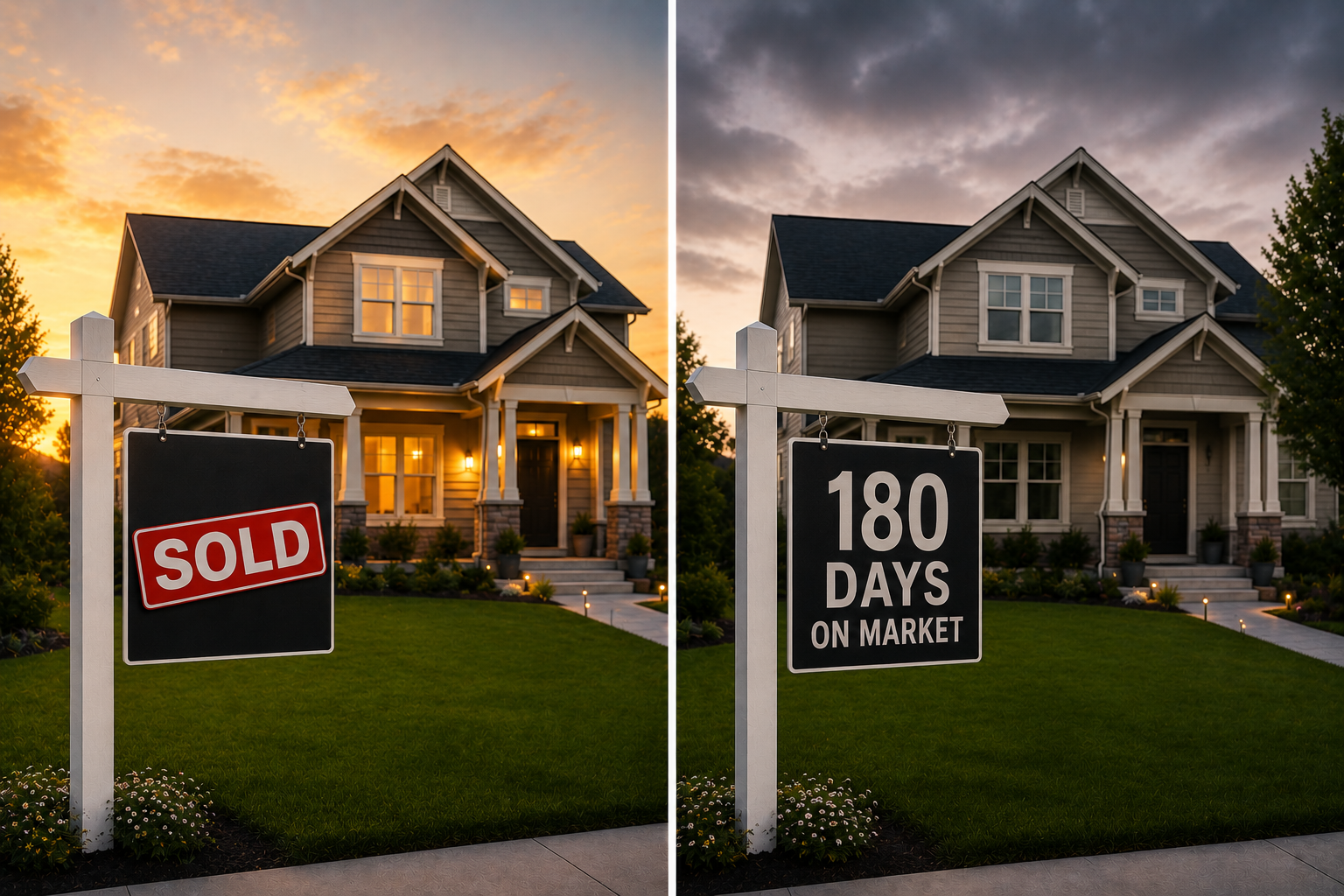
Pricing your Saratoga Springs home correctly is the single most important decision you'll make as a seller in 2026 — and the MLS data from this year makes that case more clearly than anything I could say on my own.
I pulled every closed residential sale in Saratoga Springs since January 1, 2026. 513 closed transactions. Every price, every days-on-market number. And what it shows is one of the clearest pictures of a two-speed market I've seen in Utah County.
The headline: homes that priced correctly from day one walked away with more money in less time. Homes that tested the market high sat, took cuts, and still netted less.
Here's exactly what the numbers say — not national averages, not Redfin estimates. The actual Saratoga Springs MLS data from 2026.
Utah is a non-disclosure state. Individual sale prices are not public record. All data below is presented as neighborhood-level and aggregate statistics.
The Saratoga Springs Market in 2026: What 513 Closed Sales Actually Show
Median days on market: 68 days Average days on market: 89.6 days Median sold price: $499,000 Homes that sold below their original list price: 68.4% — that's 351 out of 513 homes
That last number deserves to sit for a moment. Nearly 7 out of 10 homes sold in Saratoga Springs this year sold for less than they were originally listed for. The market is not rewarding wishful pricing. It's penalizing it, consistently, and the data is unambiguous.
But here's the other side of that same data: 25.1% of homes sold in 30 days or less. And 31.6% of all homes sold at or above their original list price. The demand is real. The buyers are there. They're just buying the homes that are priced right — and walking past the ones that aren't.
The Two-Speed Market: The Numbers Are Stark
Here's the breakdown of all 513 sales by how long they sat — and what it cost sellers who waited:
| Speed | Homes | % of Market | Median Sold Price | Median Price Cut |
|---|---|---|---|---|
| 1–14 days | 72 | 14.0% | $520,500 | $0 |
| 15–30 days | 57 | 11.1% | $459,990 | $3,615 |
| 31–90 days | 148 | 28.8% | $511,255 | $10,095 |
| 90+ days | 208 | 40.5% | $489,951 | $23,950 |
Read that table carefully. The homes that sold in the first two weeks took zero price cuts and netted a median of $520,500. The homes that sat over 90 days — which is nearly 41% of the market — took a median price cut of $23,950 and still netted $30,000 less.
That $23,950 is not what they reduced their price. That's the gap between what they originally asked and what they actually got at the closing table. It's the total cost of overpricing — the combination of price reductions, negotiated concessions, and inspection credits that pile up when a home sits.
The fastest sellers left nothing on the table. Zero median price cut. That's not luck. That's pricing strategy.
Why the First Two Weeks Define Everything
In Saratoga Springs' current market, the first 14 days on the market are not just important — they are the entire game.
Buyers in 2026 are analytical and patient. They are tracking DOM carefully. A home that has been on the market for 60 days sends a clear signal: something is wrong. It's either overpriced, has issues, or both. Buyers who are watching the market closely — and the good ones always are — see a 60-day listing and immediately assume they have leverage. They do.
New listings get maximum exposure in the first 14 days. Zillow, Realtor.com, and Redfin all surface new listings prominently. Email alerts go out to buyers who have saved their search. Agents preview new inventory with buyers who are ready to move. That initial burst of traffic is the best shot a listing will ever get — and you only get it once.
Once DOM crosses 30 days, negotiating posture shifts. This is documented clearly in real estate research. Sellers of long-listed properties are typically more motivated, which creates a window of opportunity for buyers who are paying attention. Buyers know this. They use it. Once your listing crosses 30 days, you've handed negotiating leverage to buyers — leverage you created by pricing incorrectly at launch.
The Psychology of a Stale Listing — and Why Price Reductions Don't Fix It
Here's the part most sellers don't fully understand: a price reduction after 45, 60, or 90 days doesn't reset the clock.
Buyers can see your full price history on Zillow. They can see the original list price, every reduction, and how long you've been sitting. When they see a home that started high, sat for 75 days, and just reduced — they don't think "great deal." They think "what's wrong with it?" and they offer accordingly.
The psychology is well-documented. Buyer psychology in 2026 has shifted — buyers are more patient, waiting for the "next price cut" or a better deal. A price reduction can actually signal to buyers that more reductions are coming, causing them to wait rather than act.
Minor cosmetic reductions (1–2%) often don't reset buyer psychology. However, crossing a search threshold — for example, from $635,000 to $599,000 — can dramatically increase exposure. This is why strategic pricing from day one is always better than reactive reductions later.
The practical implication: the price you should have listed at on day one is not the same as the price you need after 60 days of sitting. Every week that passes requires a deeper cut to generate the same buyer interest. The math always favors getting it right at launch.
What Overpricing Actually Costs: Real Saratoga Springs Patterns
Utah is a non-disclosure state, so we don't publish individual sale prices tied to specific addresses. But the aggregate data from 2026 tells a clear story about what overpricing costs in each subdivision.
The Village of Fox Hollow had multiple homes sitting well over 400 days before closing — with sellers giving up $40,000–$55,000 from their original list prices. That's not a price reduction. That's over a year of carrying costs plus a massive haircut.
Wildflower and Highridge are the two highest-DOM subdivisions in Saratoga Springs, averaging 146 and 163 days respectively. The median price cut in those communities runs $23,000–$24,000 off original list. Sellers who came in priced correctly in the same neighborhoods sold in a fraction of the time with minimal concessions.
The Valley at Wildflower tells the opposite story — a median DOM of just 20 days and homes selling near or at their original list prices. Same city. Same market conditions. Dramatically different outcomes — driven almost entirely by pricing discipline at launch.
The fastest individual sales in the dataset — homes that went under contract in 1–2 days — had one thing in common: they were priced correctly for 2026, not for 2022. Those sellers captured the full first-week traffic surge and converted it into clean offers.
The New Construction Competition: A Reality Saratoga Springs Resale Sellers Can't Ignore
Here's a factor that makes Saratoga Springs uniquely challenging for resale sellers right now: you are competing with brand new homes offering builder incentives.
As I covered in my post on the new subdivisions coming to Saratoga Springs in 2026, Saratoga Springs has over 860 active development projects in the pipeline. Builders like Lennar, Toll Brothers, Oakwood Homes, and Richmond American are actively selling homes in Wildflower, Wander, and other communities — and they are offering $10,000–$20,000 in closing cost credits and rate buydowns to move inventory.
A buyer comparing your resale home to a brand new home with a builder warranty and $15,000 in incentives is doing math. If your home is priced $30,000 above what the market supports, that buyer is not coming back to you. They're going to the model home.
This doesn't mean you can't compete. Resale homes have real advantages — established neighborhoods, mature landscaping, no construction noise next door, character. But you can only leverage those advantages if your price is honest.
The Saratoga Springs PID Factor: Are You Accounting for It in Your Pricing?
One pricing consideration unique to Saratoga Springs that many sellers don't fully account for: Public Infrastructure District assessments.
As I covered in my post on PIDs and what buyers need to know, some homes in Saratoga Springs carry PID assessments that add hundreds of dollars per month to a buyer's true cost of ownership — for 20–30 years. Buyers in 2026 are increasingly aware of this.
If your home carries a PID, buyers are factoring that into their monthly payment calculation. A home with a $300/month PID assessment is functionally competing with homes priced $30,000–$50,000 lower in terms of monthly cost. If you're not accounting for this in your pricing strategy, you may be listed correctly based on comparable sales but incorrectly based on what buyers can actually afford when they run their full monthly payment.
What Correct Pricing in Saratoga Springs Actually Looks Like in 2026
Here's what I tell every Saratoga Springs seller I work with:
1. Price from 2026 comps, not 2022 memory. The home that sold on your street in 2022 is not a reliable comparable for your 2026 list price. Pull the last 90 days of closed sales in your specific neighborhood — not your zip code, your neighborhood — and price from that data.
2. Know your competition, not just your comps. Your competition is every active listing in your price range in Saratoga Springs right now. If there are 15 similar homes listed, you need to be in the top third on price-to-value to generate meaningful traffic.
3. Factor in condition honestly. Buyers in 2026 are analytical. They are comparing your home to new construction with warranties, freshly updated resales, and staged inventory. If your home needs updates, that needs to be reflected in the price — not negotiated later after 60 days of sitting.
4. Price to the search threshold. Buyers search in price bands. If you list at $605,000, you're missing every buyer searching up to $600,000 and competing against higher-quality homes in the $600,000–$650,000 band. Pricing at $599,900 or $599,000 gets you in front of a dramatically larger buyer pool.
5. Build your strategy around days 1–14. Your goal is not to list high and negotiate down. Your goal is to generate maximum showing activity in the first two weeks — because that's when your leverage is highest, your competition is lowest, and your pool of interested buyers is at its peak.
If Your Saratoga Springs Home Is Already Sitting — Here's What to Do
If you're reading this and your home has been on the market for 45, 60, or 90+ days, the situation is fixable — but it requires an honest conversation.
Step 1: Pull the last 30 days of closed comps. Not from when you listed. From right now. The market may have shifted since you listed, and your pricing needs to reflect current reality.
Step 2: Make the reduction meaningful. A $5,000 price reduction on a $620,000 home doesn't move the needle. It needs to cross a search threshold, generate new buyer traffic, and signal that you're serious. A meaningful reduction gets you in front of buyers who've never seen your listing before.
Step 3: Refresh the presentation. If photos, staging, and marketing haven't changed since you listed, a price reduction alone won't solve the problem. A new set of professional photos, refreshed staging, and a relaunched marketing campaign alongside the price change gives buyers a reason to look again.
Step 4: Address the underlying issue honestly. Sometimes a home sits because of something beyond pricing — a location issue, a layout problem, a condition concern. An honest conversation with your agent about what buyers are saying in showings is essential. You can't fix what you haven't named.
The good news: Saratoga Springs is not a broken market. Hot homes in Saratoga Springs can still sell in around 19 days. The demand is there. The buyers are there. They're just more selective, more data-driven, and less forgiving of overpricing than they were three years ago.
The Bottom Line for Saratoga Springs Sellers in 2026
The first two weeks are not a warm-up. They are the main event.
Every showing you generate in days 1–14 is a buyer who came because they were genuinely excited about your home. Every showing you generate in days 60–90 is a buyer who's looking for a deal because something didn't sell. The difference in negotiating power between those two scenarios is significant.
Overpricing is not a conservative strategy in 2026. It's an expensive one. It costs you time, leverage, and ultimately money — while handing that leverage directly to the buyers you were trying to get top dollar from.
In Saratoga Springs right now, the sellers who price correctly from day one are winning. The ones who test the market high are learning an expensive lesson.
Related reading:
- Should You Sell Your Saratoga Springs Home If You Have a 3% Mortgage Rate?
- New Subdivisions and Developments Coming to Saratoga Springs in 2026
- Buying New Construction in Eagle Mountain? There May Be a Hidden Tax on Your Home
- I Can't Afford to Sell My Utah County Home — But What If Staying Is Costing You More?
Frequently Asked Questions
How long does it take to sell a home in Saratoga Springs, Utah in 2026? Based on 513 closed sales since January 1, 2026, the median is 68 days and the average is 89.6 days. However, homes that are correctly priced sell dramatically faster — 25% of all Saratoga Springs homes sold in 30 days or less, and 14% sold in 14 days or less.
What is the median home sale price in Saratoga Springs in 2026? The median sold price across all 513 transactions since January 1, 2026 is $499,000.
How much do overpriced homes lose in Saratoga Springs? Based on actual 2026 MLS data, homes that sat 90 or more days on market took a median price cut of $23,950 from their original list price. Homes that sold in 30 days or less took a median cut of $0. The difference in final sale price between fast sellers and slow sellers was approximately $30,000.
What percentage of Saratoga Springs homes sell below list price? In 2026, 68.4% of Saratoga Springs homes sold below their original list price — that's 351 out of 513 closed sales. Only 31.6% sold at or above their original asking price.
Which Saratoga Springs subdivisions are selling the fastest? Based on 2026 MLS data, The Valley at Wildflower has the fastest median DOM at 20 days. Wander and Brixton Park are also moving in 31–40 days. The slowest-moving neighborhoods are Highridge (163 days median), Wildflower (146 days), and Ridgehorne (133 days).
Why does overpricing hurt a home sale in Saratoga Springs? New listings receive their maximum buyer exposure in the first 14 days — email alerts fire, agents preview with buyers, and the listing appears prominently on Zillow and Redfin as new inventory. Once that window closes, traffic drops and buyers who do visit assume the seller is motivated and negotiate harder. Price reductions don't reset buyer psychology — buyers see the full price history.
What should I do if my Saratoga Springs home has been sitting on the market? Pull current comps from the last 30 days, make a meaningful price reduction that crosses a buyer search threshold, and refresh your photos and staging simultaneously. A price drop alone without updated presentation rarely generates a reset.
How does new construction competition affect Saratoga Springs resale sellers? Saratoga Springs has over 860 active development projects in the pipeline, with builders in Wildflower, Wander, and other communities offering $10,000–$20,000 in closing cost credits and rate buydowns. Buyers compare resale homes directly to new construction. Resale sellers who price above market are losing buyers to builders offering better value and financial incentives.
All market data sourced from MLS records of closed residential sales in Saratoga Springs, Utah, January 1–May 2026. 513 total transactions analyzed. Utah is a non-disclosure state — individual sale prices are not public record.