


Important disclaimer: I am not a tax expert or attorney. This post is for informational purposes only and does not constitute tax or legal advice. Every homeowner's situation is different. Before making any decisions based on the information here, please consult a licensed CPA or tax attorney who is familiar with Utah law.
Most Utah homeowners are sitting on a significant tax advantage they either don't fully understand or aren't using to its fullest. Utah's property tax structure is genuinely favorable compared to most of the country — and for homeowners who qualify for additional relief programs, the savings can be meaningful. But several of these programs require action to access, and some — particularly for new construction buyers — can be missed entirely if no one points them out.
This post covers every major property tax exemption available to Utah homeowners in 2026, how each one works, who qualifies, and how to check whether you're already receiving the ones you should be.
The Foundation: Utah's Effective Property Tax Rate
Before getting into specific exemptions, it helps to understand why Utah's property taxes are already among the lowest in the country.
According to AskDoss's March 2026 analysis of Utah property tax, Utah's effective property tax rate for owner-occupied homes is approximately 0.55% — roughly half the national average of 1.10%. The mechanism behind this is the primary residence exemption, which reduces the taxable value of qualifying homes to just 55% of their assessed fair market value.
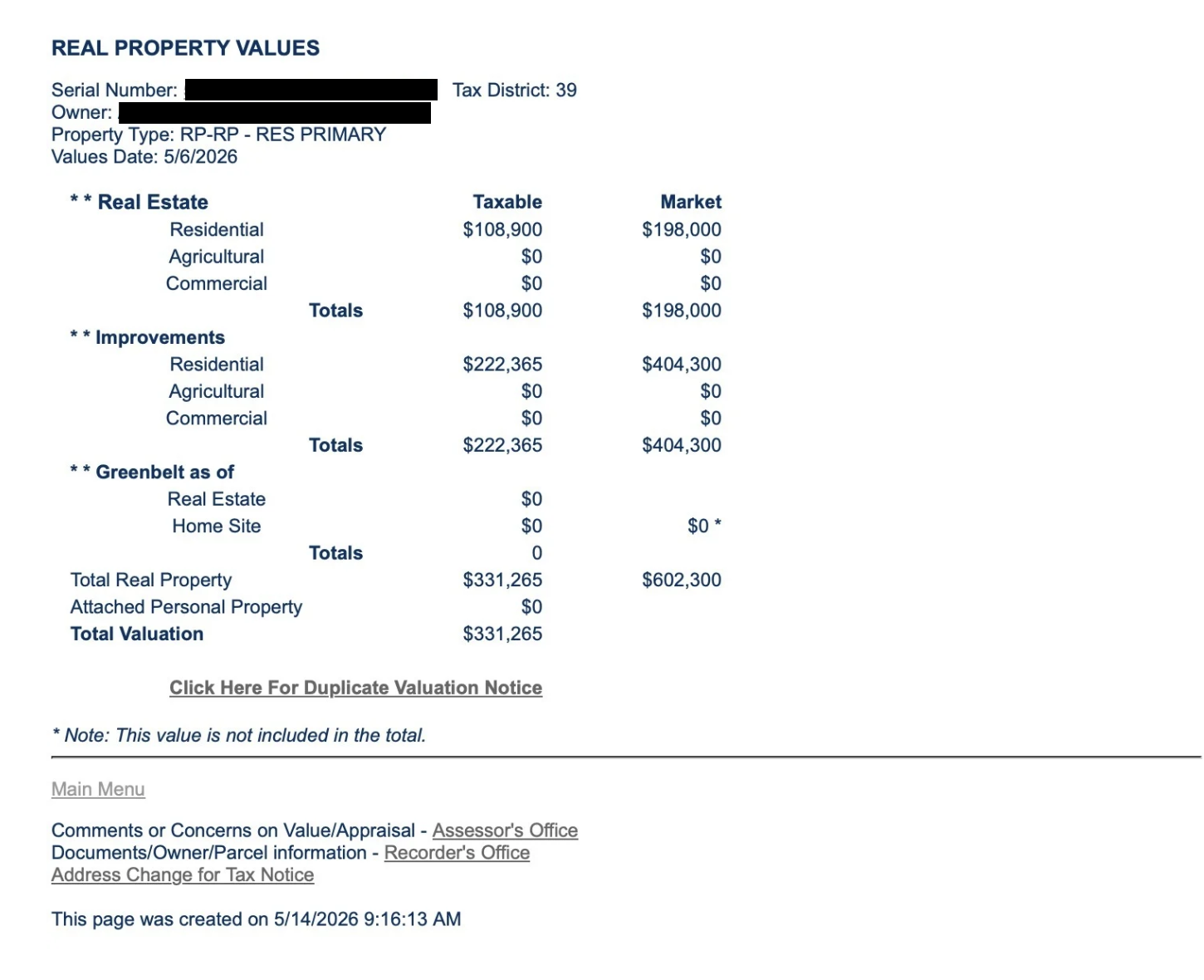
The math: a home with a market value of $602,300 has a taxable value of $331,265 after the 45% exemption. At a combined tax rate of roughly 1.0%, the annual property tax bill is approximately $3,313 rather than $6,023. The exemption saves the average Utah County homeowner thousands of dollars every year.
And importantly: this exemption is embedded in the Utah State Constitution (Article XIII, Section 2) — it cannot be removed by the legislature without a constitutional amendment approved by Utah voters.
Quick Reference: Utah County Tax Relief Programs 2026
| Program | Who Qualifies | Benefit |
|---|---|---|
| Primary Residence Exemption | All primary homeowners | 45% off assessed value |
| Circuit Breaker | Age 66+, income under $42,623 | Up to $1,312 credit + valuation reduction |
| CB75+ Deferral | Age 75+, income under $85,246 | Defer taxes until sale |
| Disabled Veteran | 10%+ VA rating | Up to $535,459 exempt taxable value (2026) |
| Blind Exemption | Legally blind | Similar structure to veteran exemption |
| Active Duty Military | 200+ days deployed outside Utah | Exemption on primary residence |
Exemption 1: The Primary Residence Exemption (The Big One)
Who this applies to: Every Utah homeowner whose property is their primary residence.
What it does: Exempts 45% of the fair market value of your primary residence and up to one acre of land from property taxation. Your taxable value is 55% of assessed market value.
The legal authority: Utah State Constitution, Article XIII, §3, and Utah Code Ann. §§ 59-2-102 and 59-2-103, administered by the Utah State Tax Commission.
How to qualify: Your home must be your primary domicile — where you live most of the year. Utah Code defines a primary residence as a home occupied for 183 or more consecutive calendar days during the calendar year. You can only claim one exemption per household statewide. Second homes, vacation properties, short-term rentals, and condominiums in rental pools do not qualify.
The new construction warning: New construction homes may default to a non-residential classification in the county assessor's system. If you recently bought new construction in Eagle Mountain, Saratoga Springs, or anywhere in Utah County — verify on your first tax bill that the exemption is applied. If it isn't, submit Form PT-19A (Residential Property Declaration) to the county assessor immediately.
This is one of the most common and costly oversights I see with new construction buyers. It's correctable — but you have to catch it. As I covered in my new construction buyer guide for Utah County, hidden costs after closing are real — and this is one of the most fixable ones.
How to Look Up Your Utah County Property Tax Records in 2 Minutes
Utah County has one of the most user-friendly property search tools in the state. Checking whether you're receiving your exemption takes less than two minutes and requires no account or login.
Step 1: Search for your property
Search by address: utahcounty.gov/LandRecords/AddressSearchForm.asp
Step 2: Click the serial number
Once your property appears in the results, click on the serial number — the long hyphenated number next to your property name.
Step 3: Click the "Value History" tab
At the top of your property record page you'll see several tabs. Click on Value History.
Step 4: Click the most recent year
A list of years will appear. Click on the most recent year to see your current assessment.
Step 5: Read your results
✅ You ARE receiving the exemption if:
- Your Property Type says RES PRIMARY (or RP-RP - RES PRIMARY)
- Your Total Taxable Value is approximately 55% of your Total Market Value
- Example: Market Value $602,300 → Taxable Value $331,265 = 55% ✅
❌ You are NOT receiving the exemption if:
- Your Property Type says "Secondary," "Commercial," or anything other than residential primary
- Your Total Taxable Value equals your Total Market Value (same number in both columns)
Step 6: Contact the assessor if something looks wrong
Utah County Assessor's Office | 100 East Center Street, Suite 1100, Provo, UT 84606 | Phone: (801) 851-8244
Most issues are correctable — but they require you to catch them first.
What Real Homeowners Are Saying
On r/Utah and r/SaltLakeCity, threads about property taxes come up regularly — often from buyers who just received their first tax bill after moving in and were surprised by the number. The consistent advice: check your valuation notice as soon as it arrives in late July or August, compare your market value to your taxable value, and contact the county assessor immediately if they match. Acting early means the exemption may be included on your October/November tax bill rather than requiring a refund process.
Exemption 2: Circuit Breaker — Senior and Low-Income Relief
Who this applies to: Homeowners who are 66 or older (or an unmarried surviving spouse of any age) with household income below $42,623 for 2024.
What it does: Provides a property tax credit of up to $1,312 — plus an additional credit equal to the taxes on 20% of the home's fair market value. According to the AARP Foundation's Property Tax-Aide program, the combination can reduce effective property tax to near zero for qualifying households.
How to apply: Online through Utah's Taxpayer Access Point at tap.utah.gov, or by completing form TC-90CY and filing with your county auditor by September 1 to appear on your October/November tax notice. December 31 is the final deadline.
Who should know about this: If you have a parent or grandparent who is a Utah homeowner in this income range, they may be eligible for meaningful relief they haven't applied for.
Exemption 3: CB75+ Property Tax Deferral
Who this applies to: Homeowners 75 or older with household income below $85,246 (2025 threshold) who have owned the property for 20+ years OR whose income is below the limit.
What it does: Qualifying homeowners can defer property taxes instead of paying annually. Taxes accrue with interest at half the normal rate and become due when the property is sold or transferred. Per the Utah State Tax Commission's Standards of Practice (revised May 2025), this is mandatory relief — the county must grant it if you qualify and apply.
How to apply: Through the Utah County Auditor's office annually. Deadline is September 1 each year.
Exemption 4: Disabled Veteran Exemption
Who this applies to: Honorably discharged veterans with a VA disability rating of 10% or higher. Also available to the unmarried surviving spouse or minor orphaned child of a veteran killed in the line of duty.
What it does: Per the Utah County Auditor's 2026 tax relief page, the maximum annual benefit for 2026 is $535,459 in exempt taxable value — effectively eliminating property taxes for most 100%-rated veterans in Utah County. The benefit scales with disability percentage starting at 10%.
Important: Veterans with an "Individual Unemployability" (IU) VA classification are treated as 100% disabled for this exemption — regardless of their listed percentage.
How to apply: Through the Utah County Auditor's office with VA documentation by September 1.
Exemption 5: Blind Exemption
Who this applies to: Homeowners legally blind in both eyes, documented by a licensed ophthalmologist. Also available to an unmarried surviving spouse or minor orphan.
How to apply: Through the Utah County Auditor's office. Check the current application page as the system was updated in April 2026.
Exemption 6: Active Duty Military Deployment
Who this applies to: Active duty military members deployed outside Utah for 200 or more days.
Important timing: Per the Utah County Auditor, the application cannot be submitted until the year after deployment was completed. A 2025 deployment qualifies for a 2026 exemption. The property must remain your primary residence and cannot be rented during the deployment period.
Capital Gains When You Sell Your Utah Home
I am not a tax advisor or attorney. Please consult a CPA before relying on any of the following for your specific situation.
The Federal Section 121 Exclusion
Under Section 121 of the U.S. Internal Revenue Code, if you have owned and used your home as your primary residence for at least 2 of the last 5 years before selling, you may exclude a significant portion of your capital gain from federal income tax:
- Single filers: Exclude up to $250,000 of capital gain
- Married filing jointly: Exclude up to $500,000 of capital gain
The two years of ownership and occupancy do not need to be consecutive. This exclusion can only be used once every two years.
A practical example: If you purchased your Eagle Mountain home in 2020 for $380,000 and sell it today for $520,000, your capital gain is $140,000. As a married couple filing jointly, the $500,000 exclusion covers it entirely — no federal capital gains tax owed.
Any gain above your applicable exclusion amount is taxed at 0%, 15%, or 20% depending on your income — per long-term capital gains rates for 2026 via HomeLight.
Utah State Capital Gains
Utah taxes all capital gains as ordinary income at the state's flat rate of 4.55% — no distinction between short-term and long-term. If your gain is excluded federally under Section 121, the excluded portion is generally not subject to Utah state income tax either.
Utah Is a Non-Disclosure State — This Does Not Affect Your Tax Obligation
Utah being a non-disclosure state means sale prices are not part of the public record. It does not exempt you from reporting capital gains. Title companies file 1099-S forms with the IRS on most real estate transactions regardless.
Home Improvements Reduce Your Taxable Gain
Capital improvements added to your cost basis reduce your taxable gain when you sell. A finished basement, new roof, or added bathroom — all documented — increase your basis and lower what you'll owe. Keep records throughout your ownership.
The Depreciation Recapture Warning
If you ever rented your home or claimed a home office deduction, a portion of your gain may be subject to depreciation recapture at a maximum federal rate of 25%. Discuss this with a CPA before listing if your home was ever used as a rental, even partially.
The Bottom Line
Most Utah County homeowners are already receiving the primary residence exemption — but not everyone. New construction buyers are the most common exception, and it's entirely fixable once you know to check.
Take two minutes right now and look up your property at utahcounty.gov/LandRecords/AddressSearchForm.asp. Click the serial number, go to Value History, click the most recent year, and confirm your Taxable Value is approximately 55% of your Market Value. If it is — you're good. If it isn't — call the assessor's office.
And if you're thinking about selling and want to understand what your home is actually worth — not what the county assessed it at, and not what Zillow says — I'm happy to put together a real, MLS-based valuation for you within 48 hours.
Get Your Free Home Valuation →
Frequently Asked Questions
How do I check if I'm receiving the Utah property tax exemption? Go to utahcounty.gov/LandRecords/AddressSearchForm.asp, enter your address, click the serial number, click the Value History tab, and select the most recent year. If your Property Type says "RES PRIMARY" and your Total Taxable Value is approximately 55% of your Total Market Value — you are receiving the exemption. If the two values are the same, you are not and should contact the Utah County Assessor immediately at (801) 851-8244.
Do Utah homeowners automatically get the 45% property tax exemption? Most do, but not always. New construction may default to a non-residential classification until a Residential Property Declaration (Form PT-19A) is submitted. Check your first property tax notice and verify your values using the Utah County property search tool.
Who qualifies for the Circuit Breaker property tax credit in Utah? Homeowners who are 66 or older (or an unmarried surviving spouse of any age) with 2024 total household income below $42,623. The credit can reduce taxes by up to $1,312 plus additional valuation-based relief. Apply online at tap.utah.gov or through the Utah County Auditor's office by September 1.
What is the disabled veteran property tax exemption in Utah County? Veterans with a VA disability rating of 10% or higher qualify for a property tax exemption scaled to their disability percentage. For 2026, the maximum annual benefit is $535,459 in exempt taxable value — effectively eliminating property taxes for most 100%-rated veterans. Veterans with an "Individual Unemployability" VA classification are treated as 100% disabled regardless of their listed rating.
Do I owe capital gains tax when I sell my Utah home? It depends on your gain and situation. Under IRS Section 121, if the home was your primary residence for at least 2 of the last 5 years, you can exclude up to $250,000 (single) or $500,000 (married filing jointly) of capital gain from federal income tax. Utah taxes any remaining gain as ordinary income at 4.55%. Consult a CPA for your specific situation.
Does Utah's non-disclosure law mean I don't have to report capital gains? No. Non-disclosure means sale prices are not public record — it does not affect your tax reporting obligations. Title companies still file 1099-S forms with the IRS on most real estate transactions.
Can home improvements reduce my capital gains when I sell? Yes. Capital improvements — a finished basement, new roof, added bathroom — increase your cost basis and reduce your taxable capital gain. Keep documented records of all capital improvements throughout your ownership.
Related reading:
- Is Utah County a Good Place to Live? Pros and Cons 2026
- Why Your Zestimate Is Wrong in Utah — Saratoga Springs
- How Much Equity Do I Have in My Saratoga Springs Home?
- Build From Dirt vs. Quick Move-In in Utah County — New Construction Guide
- Can Your Utah County HOA Raise Its Fees? What the Law Says
- I Can't Afford to Sell My Utah County Home — But What If Staying Is Costing You More?
Sources: Utah State Tax Commission — Primary Residential Exemption; Utah State Constitution Article XIII §3; Utah Code Ann. §§59-2-102 and 59-2-103; Utah County Auditor — Tax Relief 2026; Utah State Tax Commission — Publication 36, May 2025; Utah State Tax Commission — Standards of Practice 3, May 2025; AARP Foundation Property Tax-Aide — Utah; AskDoss — Utah Property Tax 2026, March 2026; IRS — 26 USC §121 Exclusion of gain from sale of principal residence; HomeLight — Taxes on Selling a House in Utah, 2026.
Written by Kat Ashby, Principal Broker and Realtor® at RootQuest Realty LLC in Saratoga Springs, Utah. Kat holds a Utah Division of Real Estate Principal Broker license (Credential #10382396-PB00) — a designation that requires demonstrated experience, additional coursework, and a separate licensing exam beyond the standard agent license. She has been actively selling in Utah County since 2020, with deep experience across Lehi, Eagle Mountain, Saratoga Springs, and the broader Wasatch Front, specializing in buyer representation, new construction, and corporate relocation through Altair Global. She is fluent in English and Portuguese, earned her bachelor's degree in Psychology from Brigham Young University, and lives in the community she sells in.