


Most Utah County buyers have never thought about radon. It doesn't come up in casual conversation, it doesn't show up on a seller's disclosure unless levels are known to be elevated, and it's completely invisible — no smell, no color, no taste. You can't detect it without a test.
Here's why it matters specifically in Utah: Utah has 5x more homes with high radon levels than the national average, with nearly 1 in 3 Utah homes having radon levels above the EPA's action level of 4.0 pCi/L. Lung cancer is the leading cause of cancer death in Utah even though the state has the lowest percentage of adult smokers in the country — and radon exposure is widely cited as a contributing factor.
The good news: you can get a free radon test kit. And if mitigation is needed, the cost in Utah County ($910–$1,617) is typically handled as a seller credit at closing.
What Is Radon and Why Does It Matter?
Radon is a naturally occurring radioactive gas produced by the decay of uranium in soil, rock, and water. As the Utah Geological Survey explains, Utah's geology is rich in uranium — which means radon is produced throughout the state as that uranium slowly breaks down underground.
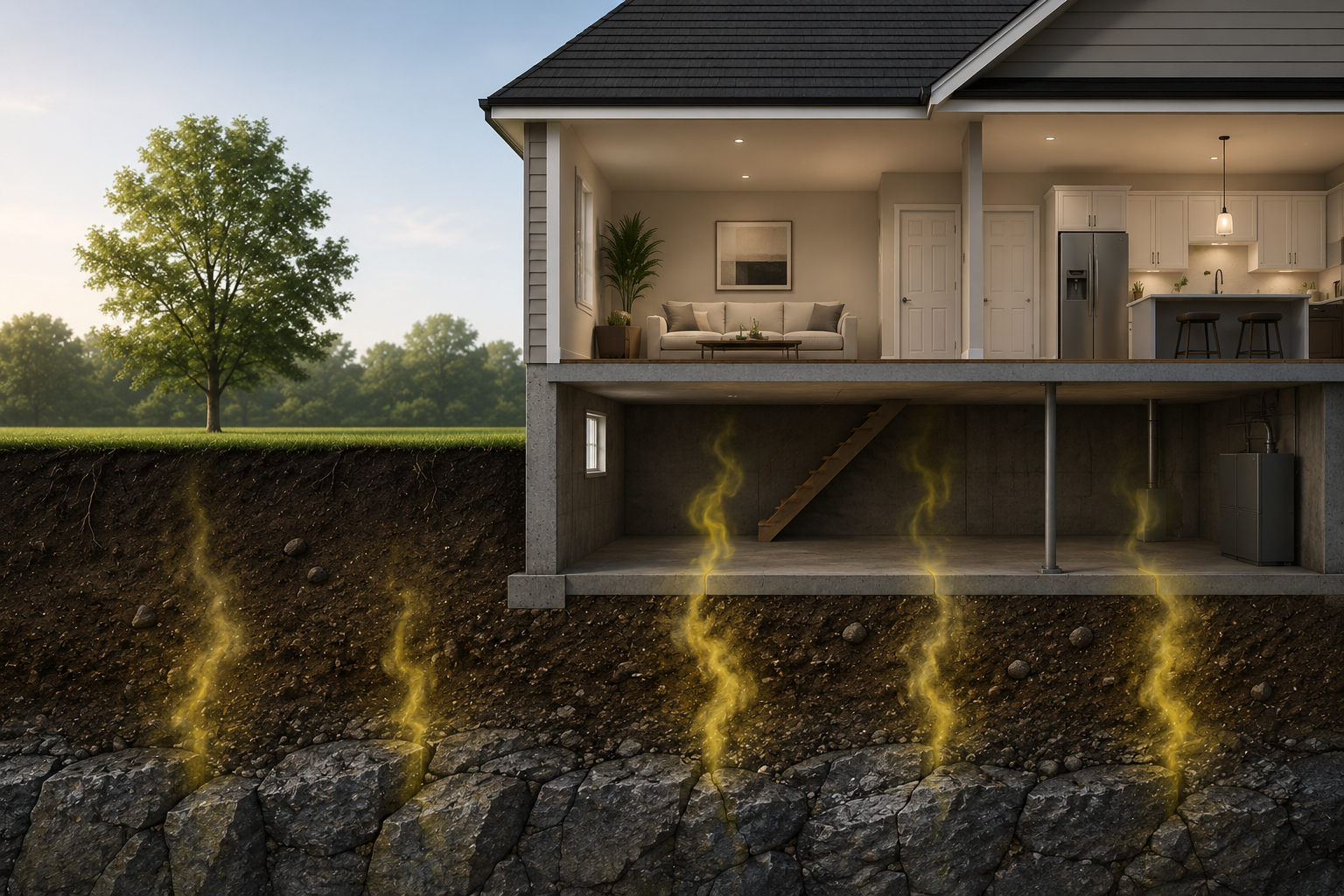
Outdoors, radon disperses harmlessly. The problem is what happens indoors. When radon seeps into a home through cracks in the foundation, gaps around pipes, or porous building materials, it accumulates in enclosed spaces. Radon is the second leading cause of lung cancer in the United States — behind only smoking. An estimated 15,600 to 19,300 Americans die from radon-induced lung cancer every year.
There is no safe level of radon exposure. The EPA recommends mitigation when indoor levels reach or exceed 4.0 pCi/L. The World Health Organization uses a tighter threshold of 2.7 pCi/L.
Utah County's Radon Classification — and Why "Zone 2" Doesn't Mean Safe
Per the EPA's Map of Radon Zones, Utah County is classified as EPA Zone 2 — meaning the predicted average indoor screening level falls between 2.0 and 4.0 pCi/L. But radon concentrations vary dramatically from house to house based on foundation type, soil permeability, and ventilation. Many individual homes in Zone 2 counties test well above 4.0 pCi/L.
Not a single county in Utah is classified as Zone 3 (low risk). According to RadonByZipCode's 2026 EPA data, Utah has 7 Zone 1 counties, 22 Zone 2 counties, and zero Zone 3 counties. Every county carries at least moderate risk.
An Important Thing Most Buyers Don't Know: Radon Levels Can Rise Over Time
A low radon test result when you move in is not a permanent guarantee. Here's why:
As a home ages and settles, small cracks develop in the foundation slab and basement walls. These new cracks create new entry points for radon to enter from the soil. A home that tested at 1.5 pCi/L when it was new can test at 4.0+ pCi/L ten years later — not because anything dramatic happened, but because normal settling over time created new pathways.
This is especially relevant in Utah County's new construction market. The home you buy in a new development in Eagle Mountain or Saratoga Springs will settle. The ground shifts. The concrete cracks minutely. The radon picture changes.
This is why the EPA recommends retesting every two years — and why continuous monitoring makes sense for many Utah County homeowners.
🆓 Where to Get a Free Radon Test Kit in Utah
Utah Radon Services — Free Test Kit utahradonservices.com/radon-test — Utah's largest radon company, certified by AARST, over 1,000 5-star Google reviews.
UtahRadon.org — State Program Free Kits utahradon.org — The Utah state radon program offers free test kits to Utah households.
Utah Radon Coalition — Free Kits + Low-Cost Mitigation utahradoncoalition.org — Free kits for all Utah residents 18+ and free-to-low-cost mitigation assistance for qualifying households.
Testing: What It Costs and How It Works
Short-Term Test Kit — Free to $30 A charcoal canister placed in the lowest livable level for 48–96 hours, mailed to a lab. Get one free from the sources above, or purchase at home improvement stores.
Professional Testing — $100–$300 A continuous electronic monitor placed for 48 hours. Worth considering for borderline results or complex home layouts.
When to Test Winter testing produces more accurate results — homes are more tightly sealed. Always test the lowest livable level.
Understanding Your Results
| Radon Level | What It Means | What to Do |
|---|---|---|
| Below 2.0 pCi/L | Below WHO and EPA thresholds | No action required; retest every 2 years |
| 2.0–2.6 pCi/L | Below EPA; below WHO reference | Monitor; consider mitigation with heavy basement use |
| 2.7–3.9 pCi/L | Below EPA; above WHO threshold | Mitigation is reasonable |
| 4.0 pCi/L and above | At or above EPA action level | Mitigation required per EPA guidance |
What Mitigation Costs in Utah County
Utah County mitigation cost: $910–$1,617, average $1,263 — per RadonVerdict's 2026 local pricing data. Utah Radon Services puts the statewide range at $1,800–$2,300 depending on complexity.
The standard system is sub-slab depressurization — a PVC pipe through the slab connected to a continuously running fan that draws radon from beneath the foundation and exhausts it outside. Runs 24/7, uses less electricity than a light bulb, reduces levels by up to 99%.
Who pays? In most Utah County real estate transactions, the buyer requests a seller credit at closing equal to the estimated mitigation cost.
Which Utah County Builders Include Radon Mitigation Systems?
Not all builders are equal on this. Here's what the research shows — and one important caveat: builder policies can change, so always confirm directly with your specific builder's sales rep before assuming a system is included.
✅ Active mitigation system included (pipes + fan): D.R. Horton — per Deseret News reporting, D.R. Horton began installing active mitigation systems in 2003 after learning about the health risks of radon exposure. This is the most protective option — an active fan-powered system rather than just rough-in pipes.
✅ Include radon protection in their plans: According to UtahRadon.org, Richmond American, Symphony Homes, Toll Brothers, and Woodside Homes include radon protection in their Utah builds. Note: this source does not specify whether these are active (fan) or passive (pipes only) systems — confirm with the builder directly.
⚠️ Passive system only (pipes, no fan): Per Deseret News reporting, McArthur Homes installs passive systems. A passive system is better than nothing — a fan can be added later to convert it to active for a few hundred dollars.
❌ Leaves it to buyer choice: Per Deseret News, Ivory Homes — the largest builder in Utah — does not automatically install a passive system, though they discuss radon with buyers during the contract process.
⚠️ Critical note: Per the Deseret News, certified radon mitigator John Seidel encounters 60 to 70 new Utah homes each year where new-construction radon work was done incorrectly — requiring a costly overhaul or entirely new system. A builder including "radon protection" in their spec sheet is not the same as it being installed correctly. Test regardless of which builder you use.
Continuous Radon Monitors: The Smart Long-Term Solution
If your home tests in the low range and you're not ready to install a mitigation system — or you simply want ongoing peace of mind — a continuous radon monitor is an excellent option.
Unlike one-time test kits, a continuous monitor tracks radon levels 24/7 and alerts you if levels rise over time. Given that radon levels can increase as a home settles, a continuous monitor gives you real-time awareness rather than a single snapshot.
Top-rated options available on Amazon:
Airthings Corentium Home (~$130–$160) Best overall pick per BobVila's 2026 testing — portable, battery-operated, easy-to-read digital display showing both short- and long-term radon levels. After 30 days you can generate a free self-inspection report. No wifi or app required — just place it and read it.
Airthings Wave Plus (~$200–$280) Best smart/app-connected option — tracks radon, CO2, VOCs, humidity, temperature, and air pressure. Color-coded LED display (green/yellow/red). Connects via Bluetooth to the Airthings app on your phone. Integrates with Amazon Alexa and Google Assistant.
⚠️ One important warning: There are many cheap radon detectors on Amazon ($30–$60) with suspiciously high ratings and fake certifications. Stick to established brands — Airthings and Ecosense RadonEye are the two most respected names in the category. As HomeHazardsReport notes, all monitors on their recommended list have been validated against EPA testing protocols.
Continuous monitor vs. periodic test kit: A continuous monitor is not a replacement for a professional test when buying or selling a home — it's a complement to it. For real estate transactions, use a certified test. For year-round monitoring after you move in, a continuous monitor pays for itself quickly versus buying test kits every two years.
Radon and New Construction in Utah County
Ask your builder whether Radon-Resistant New Construction (RRNC) features are included — a sub-slab gas collection layer, vapor barrier, sealed penetrations, and vent pipe. These add approximately $350–$500 to construction costs and are far cheaper to install during construction than to retrofit. Even if your builder says yes — test after move-in regardless. As noted above, incorrect installation is common.
As a Buyer: Your Action Plan
- Get a free test kit — utahradonservices.com/radon-test or utahradon.org
- Test the lowest livable level during your inspection period
- Above 4.0 pCi/L: Request a seller credit ($910–$1,617)
- Between 2.0 and 4.0 pCi/L: Consider a continuous monitor and retest in 2 years
- After closing: Consider an Airthings monitor for ongoing awareness as the home settles
As a Seller: Your Action Plan
- Test before listing — get a free kit first
- Elevated levels: Install mitigation before listing
- Keep documentation — a passing post-mitigation test is a selling point
- Know your disclosure obligations — concealing known elevated radon creates legal liability
Let's Talk About What to Watch for on Your Specific Home →
Frequently Asked Questions
Is radon a problem in Utah County? Yes. Utah has 5x more homes with high radon levels than the national average, with nearly 1 in 3 Utah homes exceeding the EPA action level. Utah County is EPA Zone 2, but many individual homes test above 4.0 pCi/L. Zero Utah counties are classified as low risk.
Can I get a free radon test kit in Utah? Yes. Utah Radon Services offers free kits at utahradonservices.com/radon-test. The state program at utahradon.org offers free kits to Utah households. The Utah Radon Coalition at utahradoncoalition.org offers free kits and low-cost mitigation for qualifying households.
Can radon levels increase in a home over time? Yes — this is important to understand. As a home settles, small cracks develop in the foundation and basement walls, creating new entry points for radon. A home that tested low when first built can develop higher levels years later. This is why the EPA recommends retesting every two years, and why continuous monitors are a smart long-term investment.
Do Utah builders include radon mitigation systems? Some do — D.R. Horton has included active mitigation systems since 2003. Richmond American, Symphony Homes, Toll Brothers, and Woodside Homes include radon protection per UtahRadon.org. Ivory Homes leaves it to buyer's choice. McArthur Homes installs passive (pipe-only) systems. Always confirm directly with your builder and test after move-in regardless — incorrect installation is common.
What is a continuous radon monitor and do I need one? A continuous radon monitor (like the Airthings Corentium or Wave Plus, available on Amazon for $130–$280) tracks radon levels 24/7 and alerts you if levels rise over time. It's an excellent option if your initial test comes back low but you want ongoing peace of mind as your home settles — without the cost of buying test kits every two years. Stick to Airthings or Ecosense RadonEye — cheap knockoffs with fake certifications are common on Amazon.
How much does radon mitigation cost in Utah County? $910–$1,617 on average based on 2026 local data, midpoint $1,263. In most real estate transactions, the buyer requests a seller credit at closing to cover this cost.
How does a radon mitigation system work? Sub-slab depressurization: a PVC pipe through the slab connected to a continuously running fan draws radon from beneath the foundation and exhausts it outside. Runs 24/7, uses minimal electricity, reduces levels by up to 99%.
Related reading:
- Meth Contamination in Utah Homes: What Every Buyer Needs to Know
- New Construction Home Inspection in Utah County: Yes, You Need One
- Why Every New Home Builder Has Bad Reviews — and What That Means for Utah County Buyers
- Build From Dirt vs. Quick Move-In in Utah County
- Why Do Home Sales Fall Through in Utah County?
Sources: Utah Radon Services — 5x national average, free test kits; UtahRadon.org — Richmond American, Symphony Homes, Toll Brothers, Woodside Homes include radon protection, June 2024; Deseret News — D.R. Horton active systems since 2003, Ivory Homes buyer choice, McArthur Homes passive systems, John Seidel 60–70 incorrect installs per year; BobVila — Airthings Corentium best overall radon monitor 2026; HomeHazardsReport — Best radon detectors validated against EPA protocols; EPA — Map of Radon Zones Utah; RadonVerdict — Utah County Zone 2 and mitigation costs 2026; RadonByZipCode — Utah zone data 2026; Utah Geological Survey — Radon hazard; Utah Radon Coalition — free kits and low-cost mitigation.
Written by Kat Ashby, Principal Broker and Realtor® at RootQuest Realty LLC in Saratoga Springs, Utah. Kat holds a Utah Division of Real Estate Principal Broker license (Credential #10382396-PB00) — a designation that requires demonstrated experience, additional coursework, and a separate licensing exam beyond the standard agent license. She has been actively selling in Utah County since 2020, with deep experience across Lehi, Eagle Mountain, Saratoga Springs, and the broader Wasatch Front, specializing in buyer and seller representation, new construction, and corporate relocation through Altair Global. She is fluent in English and Portuguese, earned her bachelor's degree in Psychology from Brigham Young University, and lives in the community she sells in.