


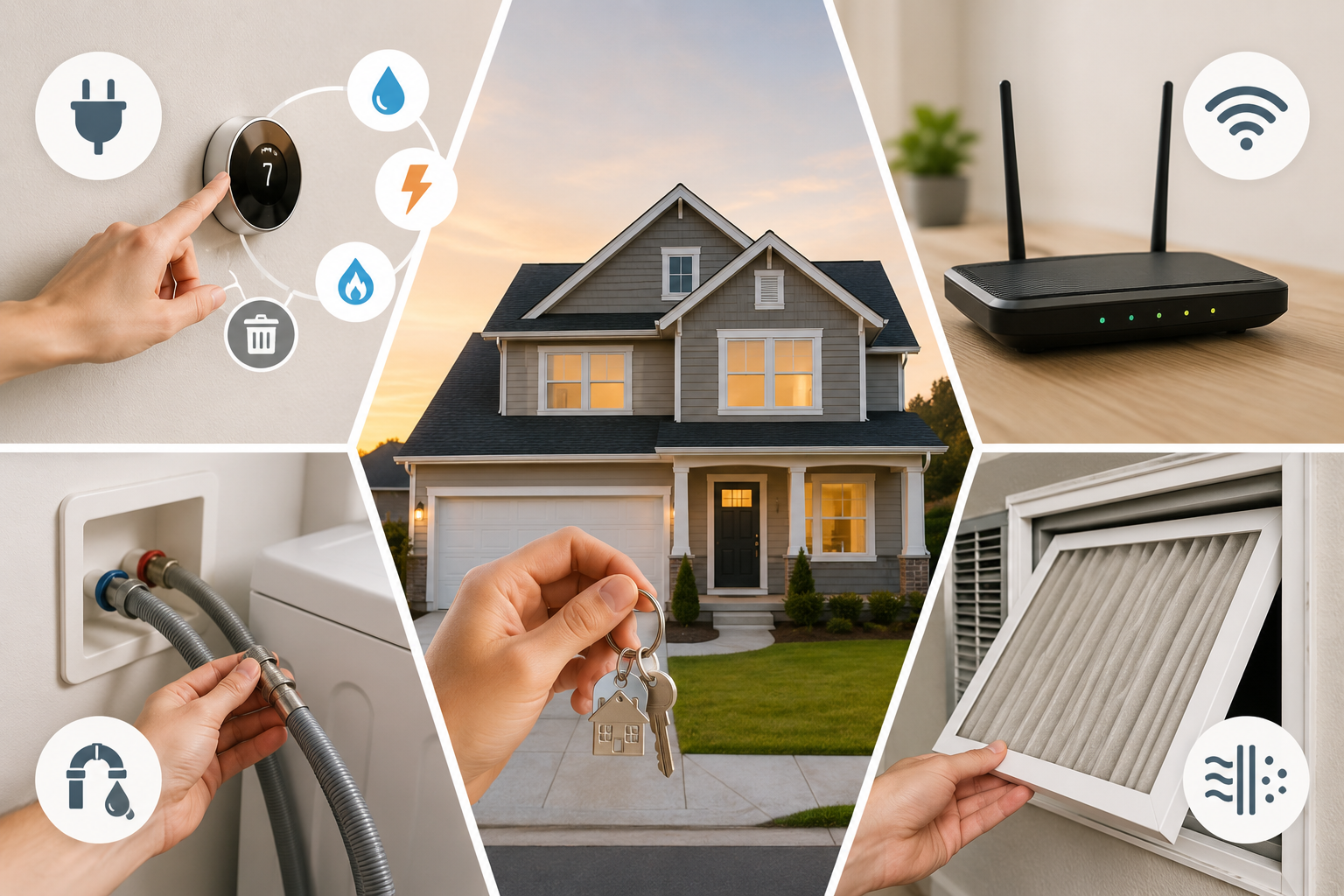
You're in the home stretch. Closing day is coming, you've got moving boxes stacked in the corner, and your brain is completely full. This is exactly when the practical stuff falls through the cracks.
Here's what I tell every buyer I work with — what to take care of the week before you close, and what to do in the first few days after you get the keys.
Before Closing: The Week Before
Set Up Your Utilities
Transfer your utilities to start on closing day — not the day after, not "sometime next week." You want power, gas, and water active the moment you walk in.
For most Utah County homes:
- Electric: Rocky Mountain Power
- Natural gas: Dominion Energy Utah
- Water/sewer/trash: Through your city — Saratoga Springs, Eagle Mountain City, or Lehi City
Schedule Your Internet Install Early
This one catches people off guard every single time. In newer developments in Eagle Mountain and Saratoga Springs, installation appointments can be 1–2 weeks out. Call your internet provider at least two weeks before closing — not the day you move in.
Figure Out Your HOA Before You Move In
If your home is in an HOA, take ten minutes before closing to find out who manages it, how dues are paid, and when the first payment is due. Most HOAs in Utah County are managed by third-party companies, and setting up your account takes a little time. Do it before you're buried in boxes.
Also worth knowing: some HOAs have move-in rules — truck size restrictions, time windows, required notice. A quick email or phone call before move-in day avoids any friction.
Do a Final Walkthrough
You're entitled to a final walkthrough before closing — usually the day before or morning of. Use it. Make sure everything agreed upon in the contract is in place, appliances are working, and the home is in the condition you expected. If something is off, your agent can address it before you sign.
After Closing: Move-In Day and the First Week
Reset Your Garage Code and Alarm System
This is quick and easy and worth doing on day one. You don't know who the previous owners gave those codes to — neighbors, contractors, family members. Resetting them takes five minutes and gives you a clean slate.
Swap Your HVAC Filter
Change it on move-in day, before you run the system. This is especially important in new construction — during the building process, a lot of dust and debris has been circulating through the ductwork.
If you're in a new development with construction still happening around you, plan to change your filter every month for the first year — not every three months like the packaging says. The construction activity on neighboring lots generates a constant stream of dust that clogs your filter surprisingly fast. I've seen filters completely black after 30 days in active Eagle Mountain and Saratoga Springs neighborhoods.
The easiest way to stay on top of it: set up an auto-delivery subscription on Amazon in your filter size. It shows up at your door and that's your reminder to swap it. Costco also often has good bulk deals on filters, so it's worth picking up a few packs when you see a good price.
One more thing: Write your filter size on a sticky note inside the HVAC closet door on move-in day. You will not remember it six months from now.
Zip Tie Your Washer Drain Hose
When you hook up your washing machine, the drain hose goes into a standpipe in the wall. If it's not secured, it can pop out mid-cycle and flood your laundry room. Secure it with a zip tie or hose strap — takes 30 seconds and costs nothing.
While you're at it, consider swapping standard rubber supply hoses for braided stainless steel ($15–$20 at any hardware store). Rubber hoses can crack over time, especially with Utah County's hard water, and a burst supply hose is a much worse situation than a loose drain hose.
Find Your Main Water Shutoff
Take five minutes and locate the main water shutoff valve — usually in the utility room, garage, or near the water meter. Make sure everyone in your household knows where it is. If a pipe ever bursts or an appliance fails, this is the valve that stops the damage.
While you're at it, find the individual shutoff valves under sinks and behind toilets. Knowing where these are before you need them is just a good thing.
The Utah-Specific Stuff
Hard Water Is Real Here
Utah County has some of the hardest water in the country — especially Eagle Mountain (25–35 GPG) and Lehi (15–28 GPG). Without a water softener, you'll notice it on your dishes, fixtures, and shower doors — and over time it shortens the life of your water heater and appliances significantly. Most new construction homes don't include a softener. It's worth budgeting for one. Full breakdown in my hard water guide for Utah County.
That Rotten Egg Smell From Hot Water
If you notice a faint sulfur or rotten egg smell coming from your hot water, don't be alarmed — it's very common in Utah County and it's not a contamination issue. It's caused by naturally occurring bacteria in groundwater reacting with the anode rod in your water heater. A water softener reduces it. Mention it to a plumber if it's strong, but it's a known Utah County thing and nothing to stress about.
Winterize Outdoor Faucets Before First Freeze
Before late October, disconnect garden hoses from exterior faucets and turn off the interior shutoff valve to each one. If you skip this, a freeze can split the pipe inside the wall. If you have a sprinkler system, schedule a professional blowout in early October — these appointments fill up fast and you don't want to be scrambling.
The Quick Reference List
Before closing:
- ✅ Utilities set up to start on closing day
- ✅ Internet install scheduled (at least 2 weeks out)
- ✅ HOA account researched, payment method identified
- ✅ Move-in rules confirmed with HOA
- ✅ Final walkthrough scheduled
After closing:
- ✅ Garage code reset
- ✅ Alarm system code reset
- ✅ HVAC filter replaced — monthly if in active new construction area
- ✅ Filter size written inside HVAC closet
- ✅ Amazon auto-delivery or bulk filters set up
- ✅ Washer drain hose zip tied to standpipe
- ✅ Braided steel washer supply hoses installed
- ✅ Main water shutoff located
- ✅ Water softener planned or ordered
- ✅ Outdoor faucets winterized before first freeze
- ✅ Sprinkler blowout scheduled (if applicable)
Have Questions Before or After Closing? Let's Talk →
Frequently Asked Questions
When should I set up utilities when buying a home in Utah County? Set them up to start on closing day — not the day after. Call Rocky Mountain Power for electric, Dominion Energy Utah for natural gas, and your city (Saratoga Springs, Eagle Mountain, or Lehi) for water and trash. Do this the week before closing, not the week after.
How early should I schedule internet installation? At least two weeks before move-in day, especially in newer Eagle Mountain and Saratoga Springs developments where installation appointments can book 1–2 weeks out. This is the one people regret not doing sooner.
What do I do about my HOA when I move in? Find out who manages it, how dues are collected, and when your first payment is due — before move-in day. Set up autopay. Check for any move-in rules around truck access or timing. A quick phone call or email before closing takes care of all of it.
How often should I change my HVAC filter in a new construction home? Every month for the first year if you're in an active new construction neighborhood — the surrounding building activity generates dust that clogs filters fast. After things settle down, once a season is typically fine. Set up Amazon auto-delivery in your filter size so you never have to remember.
What is the washer hose tip? Secure your washing machine's drain hose to the standpipe with a zip tie so it can't pop out mid-cycle. Also consider upgrading from rubber to braided stainless steel supply hoses — they last longer and handle Utah's hard water better.
Why does my hot water smell like rotten eggs? Very common in Utah County — not a contamination issue. It's caused by naturally occurring bacteria in groundwater reacting with the anode rod in your water heater. A water softener helps. Mention it to a plumber if it's strong.
Related reading:
- Hard Water in Utah County: Do You Need a Water Softener?
- HOA Fee Increases in Utah County: What Homeowners Need to Know
- New Construction Home Inspection: What to Do When Your Builder Restricts Access
- Utah Property Tax Exemptions 2026: Every Program Utah County Homeowners Should Know
- Why Every New Home Builder Has Bad Reviews
Written by Kat Ashby, Principal Broker and Realtor® at RootQuest Realty LLC in Saratoga Springs, Utah. Kat holds a Utah Division of Real Estate Principal Broker license (Credential #10382396-PB00) — a designation that requires demonstrated experience, additional coursework, and a separate licensing exam beyond the standard agent license. She has been actively selling in Utah County since 2020, with deep experience across Lehi, Eagle Mountain, Saratoga Springs, and the broader Wasatch Front, specializing in buyer and seller representation, new construction, and corporate relocation through Altair Global. She is fluent in English and Portuguese, earned her bachelor's degree in Psychology from Brigham Young University, and lives in the community she sells in.
