


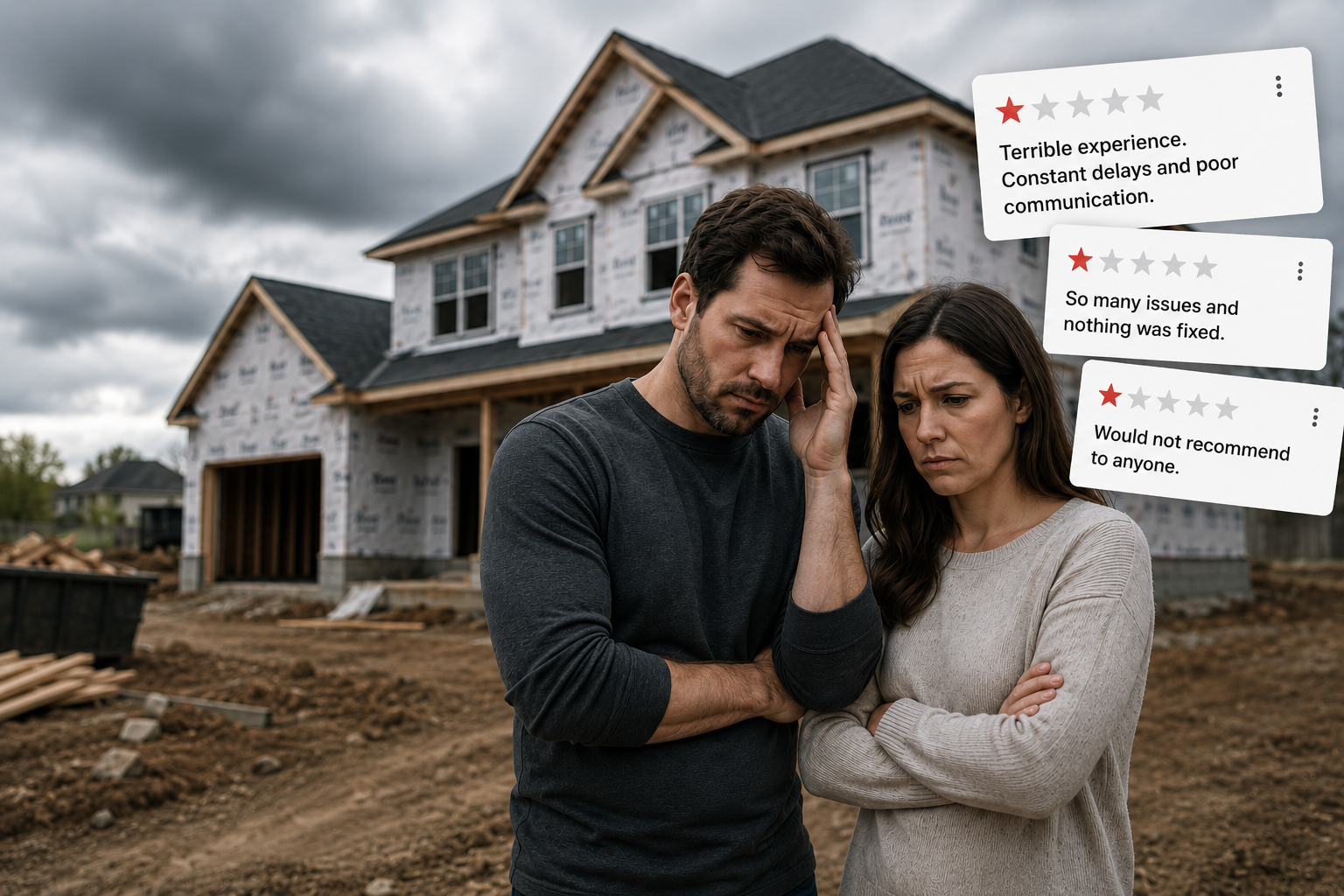
One of the most common conversations I have with new construction buyers in Utah County goes like this:
They've found a home they love. The floor plan works. The location is right. The price makes sense. And then they go online and start reading reviews. And what they find stops them cold.
Here's what the reviews actually look like for some of the builders active in Utah County right now:
Toll Brothers has a 1.6 out of 5 on Trustpilot and a 1.4 out of 5 on PissedConsumer — reviews that describe warranty delays, subcontractor issues, and post-closing unresponsiveness.
Richmond American Homes has 4 stars from 48 verified Utah buyers on NewHomeSource — a platform where builders survey buyers at move-in. One verified Utah buyer wrote in October 2025: "This is the 3rd time I've purchased a new-build home, and this is by far the best experience I've had." Yet Richmond American has harsh 1-star reviews on Trustpilot and Yelp from the same time period.
Edge Homes has complaints documented on Yelp and the BBB alongside positive reviews on their own website.
Same builders. Same state. Wildly different ratings depending on where you look and who's writing.
That's not a coincidence — it's a feature of how builder reviews work. And understanding it is one of the most useful things a Utah County new construction buyer can know.
Why the Same Builder Gets Opposite Ratings on Different Platforms
NewHomeSource surveys buyers at move-in — systematically, across all buyers. The result is a more representative sample of the full buyer experience.
Yelp, Trustpilot, and PissedConsumer are self-selected. Buyers who had a smooth experience move in and get on with their lives. Buyers who had a frustrating warranty experience have something specific to say — and a strong motivation to say it publicly.
The result is structurally guaranteed to skew negative on complaint platforms. A builder who sells 500 homes in a year and has 40 online reviews — the vast majority from unhappy buyers — has a terrible rating that tells you very little about the experience of the other 460 buyers.
According to Zillow's own research when launching their builder review feature in 2020, 76% of new construction buyers say builder reputation is important to their decision — yet the review landscape they're consulting is almost entirely made up of the subset of buyers who had a problem.
This doesn't mean the complaints aren't real. They are. But it means the star rating on a complaint site is not a reliable guide to your likely experience.
What Actually Drives Quality: The Superintendent
Here's what I tell every new construction buyer I work with, based on years of watching how this market actually works:
The brand name on the sign is less predictive of your outcome than the superintendent managing your specific community.
Production builders like Toll Brothers, Richmond American, Edge Homes, and D.R. Horton are general contractors. They don't employ the framers, plumbers, electricians, and drywall crews who build your home — they hire subcontractors. And the person responsible for overseeing all of those subcontractors on a day-to-day basis, catching their mistakes, ensuring the work meets standard, and keeping the project on track is the superintendent.
As construction quality management experts at Document Crunch explain: "The superintendent executes the daily QC operations. They coordinate the inspections and manage the deficiencies."
The same national builder can produce dramatically different outcomes across different communities — and the most significant variable is often the superintendent. A skilled, attentive superintendent who catches subcontractor errors before they're buried behind drywall produces a very different home than one who's managing too many communities simultaneously and missing things.
One verified Utah Richmond American buyer made exactly this point in their 5-star review: "HUGE SHOUTOUT to Danny, our foreman, who went above and beyond to make sure we understood everything about our new home." The foreman — the on-site superintendent equivalent — was the deciding factor.
What this means for you as a buyer: Ask your agent what they know about the superintendent on the specific community you're considering. Talk to buyers who closed on earlier phases. The person managing the day-to-day work matters more than the logo on the model home.
What the Complaints Are Actually Telling You
When you read builder reviews, most complaints cluster around two categories:
1. Warranty and post-closing service — the builder was slow to respond, didn't fix things properly, or became unresponsive after closing. This is by far the most common complaint across every platform.
2. Subcontractor finish quality — things were "painted over" rather than properly fixed, damaged items left unreplaced, work done by whoever was cheapest.
A 2025 ConsumerAffairs review of Toll Brothers put it directly: "During the construction process it seems like lots of issues are just painted over rather than remedied which gives the appearance of being complete to satisfy a final walkthrough."
A Utah Toll Brothers buyer on PissedConsumer wrote: "We just hit our year mark and STILL have issues that have not been corrected. Just 2 nights ago ALL of our warranty items were marked complete and they have absolutely not been completed."
These are real experiences. But notice what they're describing: warranty follow-through and post-closing responsiveness — not necessarily the fundamental structural quality of the home. And critically — these are buyers who were clearly frustrated after the fact. The reviews don't tell you whether they got an independent inspection, documented issues properly, or followed up persistently in writing.
What City Inspections Actually Do — and Don't Do
This is one of the most misunderstood parts of new construction, and it's worth stating clearly.
City inspections are not quality reviews. They are code compliance checks.
When a city inspector visits your home during construction, they are verifying that the work meets minimum building code requirements. They are not evaluating whether the insulation coverage is thorough or spotty, whether framing is excellent or merely adequate, or whether finish work is done well.
As FOX 13 Utah reported in an investigation into new construction quality, Utah real estate attorney John Morris said directly: "Homeowners in Utah really need to get an inspection — and not the $150 inspection. I would call that inspection worthless. You need a more serious inspection, especially of the exterior of the home. That's the critical component because that allows water penetration."
The city inspector is not your advocate. They're checking minimums on behalf of the municipality.
Additionally, KSL has reported that home inspectors are not licensed in Utah — meaning anyone can call themselves a home inspector without credentials. This makes choosing an inspector with InterNACHI or ASHI certifications especially important in Utah.
What Builder Warranties Actually Cover
Most Utah County new construction homes come with a tiered warranty structure:
- 1 year: Labor and materials — workmanship defects, mechanical system issues, cosmetic defects documented at or before closing
- 2 years: Mechanical systems (electrical, plumbing, HVAC) under many builder warranties
- 10 years: Structural defects — foundation, load-bearing walls, roof structure
What warranties typically do NOT cover:
- Normal wear and tear and settling
- Cosmetic issues not documented at closing
- Damage caused by the homeowner after closing
As Nolo's legal guide on new home defects explains, Utah's implied warranty of quality "does not protect against mere defects in workmanship, minor or procedural violations of the applicable building codes, or defects that are trivial or aesthetic."
This is why documentation at closing is critical. Walk through your home the day of closing with your phone camera. Document every imperfection before you move in. The warranty clock starts at closing.
How to Actually Protect Yourself — Regardless of Which Builder You Choose
1. Get an Independent Home Inspection
As I covered in my new construction inspection guide, you need an independent inspection regardless of which builder you're working with. Choose an inspector with InterNACHI or ASHI credentials. If the builder restricts pre-closing access, consider doing the inspection immediately after closing when you have full unrestricted access.
2. Do a Thorough Pre-Closing Walkthrough — and Document Everything
Walk through your home with your agent before closing. Document every item that needs to be addressed. Do not close with unresolved items that weren't formally committed to in writing. "We'll fix that after closing" is a promise that is much harder to enforce than a documented punch list.
3. Submit Warranty Items in Writing — Immediately
Every issue after closing should be submitted as a warranty ticket in writing. Not verbally. Not through a builder app. Email or certified mail. Document the date.
4. Schedule a Second Inspection at Month 10
At month 10 — before your one-year warranty expires — hire your inspector to come back through the home. A full year of seasons reveals things a new construction walkthrough doesn't. Submit everything they find as a warranty ticket immediately.
5. Know Who the Superintendent Is
Ask your agent what they know about the superintendent for the specific community you're considering. Talk to buyers who purchased in earlier phases of the same development. The person managing the day-to-day work matters more than the brand name.
The Bottom Line
Seeing bad reviews for a builder you're considering is not a reason to panic — and it's not a reason to ignore your instincts either.
The fact that Richmond American has 4 stars from verified Utah buyers on one platform and harsh 1-star reviews on another tells you more about how builder reviews work than it does about Richmond American. Every large builder will have frustrated buyers who post publicly. The question is whether you're in a position to protect yourself regardless of which builder you choose.
The buyers who come in prepared — who get thorough inspections, document everything, understand their warranty, and follow up persistently — have much better outcomes than buyers who assume the brand name guarantees quality.
No brand name does. The right process does.
As I covered in my guides to what Eagle Mountain builder reps won't tell you and hidden costs of new construction in Eagle Mountain, the things that catch new construction buyers off guard are almost always knowable in advance — if someone tells you where to look.
Let's Talk Through Your New Construction Purchase →
Frequently Asked Questions
Are Toll Brothers, Edge Homes, and Richmond American good builders? It depends more on the specific community and superintendent than the brand name. Richmond American, for example, has 4 stars from verified Utah buyers on NewHomeSource — and harsh reviews on Yelp from the same period. The same builder produces very different outcomes across different communities depending on who's managing the day-to-day work and which subcontractors they're using.
Why do all home builders have bad reviews? Production builders sell hundreds or thousands of homes per year. Satisfied buyers typically move in and don't post reviews. Frustrated buyers — especially those with difficult warranty experiences — have strong motivation to share publicly. The result is that reviews on complaint platforms are structurally skewed toward unhappy customers, not the typical buyer. Review platforms that survey all buyers at move-in (like NewHomeSource) tell a different story.
What does a city inspection actually cover for new construction? A city inspection verifies that construction meets minimum building code requirements. It is not a quality review. City inspectors check code compliance — they are not evaluating whether workmanship is excellent or whether finish work is properly done. You need an independent home inspection for that.
Do I need a home inspection on a brand new home in Utah County? Yes. Utah real estate attorney John Morris, quoted in a FOX 13 investigative report, said: "Homeowners in Utah really need to get an inspection — and not the $150 inspection. You need a more serious inspection, especially of the exterior of the home." Additionally, home inspectors are not licensed in Utah — choose one with InterNACHI or ASHI credentials.
What does a new construction warranty cover in Utah County? Most Utah builder warranties cover labor and materials for one year, mechanical systems for two years, and structural defects for ten years. Cosmetic issues need to be documented at or before closing to be covered. Normal wear and tear and homeowner-caused damage are not covered.
What is the most important thing to do after closing on a new construction home? Get a comprehensive independent inspection within the first few days — before anything is moved in. Submit every finding as a warranty ticket in writing immediately. Then schedule a second inspection at month 10, before your one-year warranty expires.
Related reading:
- New Construction Home Inspection in Utah County: Yes, You Need One
- What Eagle Mountain Builder Reps Won't Tell You
- Hidden Costs of New Construction in Eagle Mountain
- Build From Dirt vs. Quick Move-In in Utah County
- Buying New Construction in Eagle Mountain? There May Be a Hidden Tax (PID)
- New High School Coming to Saratoga Springs: Everything You Need to Know
Sources: NewHomeSource — Richmond American Homes Utah Reviews, 48 verified buyers, 4 stars; Trustpilot — Toll Brothers rated 1.6/5; PissedConsumer — Toll Brothers rated 1.4/5, 145 reviews; Trustpilot — Richmond American Homes reviews; Yelp — Richmond American Homes Lehi; BBB — Edge Homes Utah; ConsumerAffairs — Toll Brothers Reviews 2025; PissedConsumer — Toll Brothers Utah review; Zillow — Builder Ratings and Reviews Launch, 76% of buyers value builder reputation, 2020; Document Crunch — Quality Control in Construction, February 2026; SafetyCulture — Quality Control in Construction; FOX 13 Utah — Newly-Constructed Home Buyers Find Utah Gives Them Few Options, 2021; KSL — Home Inspectors Aren't Licensed in Utah; Nolo — New Home Defects: Holding Your Builder Responsible, December 2024.
Written by Kat Ashby, Principal Broker and Realtor® at RootQuest Realty LLC in Saratoga Springs, Utah. Kat holds a Utah Division of Real Estate Principal Broker license (Credential #10382396-PB00) — a designation that requires demonstrated experience, additional coursework, and a separate licensing exam beyond the standard agent license. She has been actively selling in Utah County since 2020, with deep experience across Lehi, Eagle Mountain, Saratoga Springs, and the broader Wasatch Front, specializing in buyer and seller representation, new construction, and corporate relocation through Altair Global. She is fluent in English and Portuguese, earned her bachelor's degree in Psychology from Brigham Young University, and lives in the community she sells in.