


You've accepted an offer on your home. The builder just pushed your move-in date back six weeks. You close in 30 days and you have nowhere to go.
Sellers in Eagle Mountain, Saratoga Springs, and Lehi run into this. They sell their current home to fund a new construction purchase — and construction timelines slip. Sometimes by weeks. Sometimes by months.
A seller leaseback is the solution that keeps everyone moving forward.
What a Seller Leaseback Is
Per Rate.com's leaseback guide, a leaseback — also called a rent-back — is a transaction where you sell your property and then lease it back from the new owner for an agreed period after closing. You close on time, access your equity, and stay in the home while you wait for your new construction to be finished.
Instead of scrambling for temporary housing, paying for storage, moving twice, or trying to time two closings perfectly — you stay put. The buyer owns the home. You rent it from them until your new home is ready.
Per Sell2Rent's 2026 leaseback guide, selling before your new construction is complete is a scenario leaseback agreements are specifically designed for. Construction delays are not unusual, and a leaseback provides the bridge that makes both transactions work.
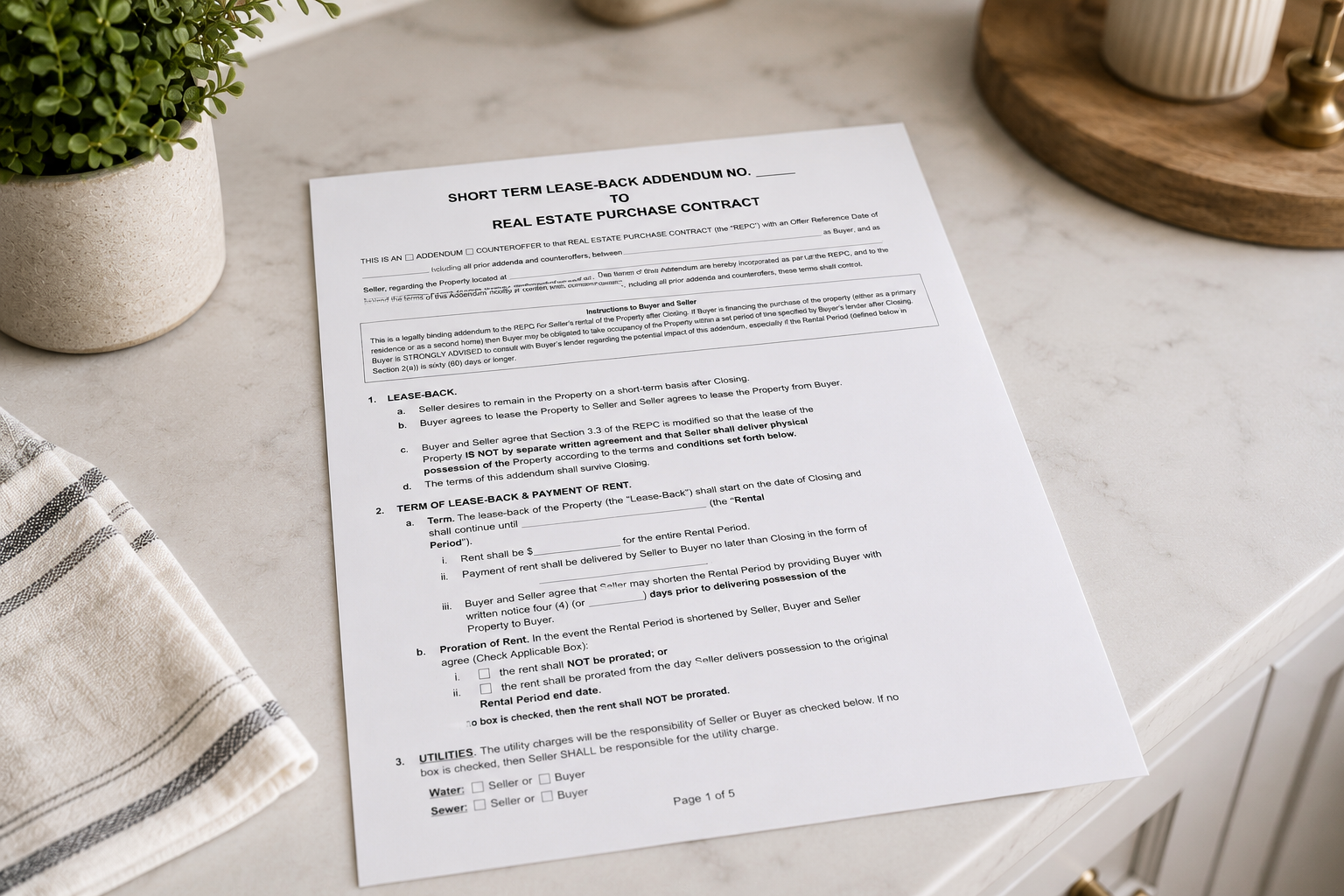
The Utah Short Term Lease-Back Addendum (UAR Form 76)
In Utah, the seller leaseback is formalized through the Short Term Lease-Back Addendum — UAR Form 76 — which attaches directly to the Real Estate Purchase Contract.
Here's what the actual form covers:
The rental period. The leaseback starts on the date of closing and continues until the agreed end date. You negotiate the date — it should be realistic plus a buffer for construction delays.
Rent. The form specifies a total rent amount for the entire rental period. Rent is typically based on the buyer's PITI — their principal, interest, taxes, and insurance payment on the new loan. Rent is paid at closing, not monthly.
Utilities. The form specifies who pays water, sewer, natural gas, garbage, and electricity during the leaseback period. Cable, internet, landscaping, and snow removal are the seller's responsibility unless the HOA covers them.
Security deposit. Collected at closing to secure your performance under the lease. Returned within 30 days of vacating, less any deductions. Utah Code Ann. 57-17-1 governs security deposits.
Right of entry. The buyer has the right to enter the property with 24 hours notice. In an emergency or if a lease violation exists, the buyer may enter without notice.
Delivery of possession. When the leaseback ends, you deliver the property in substantially the same condition as at closing — normal wear and tear excepted.
Seller's insurance. UAR Form 76 requires you to carry renters insurance during the leaseback period. This is not optional — it's in the form. Get it before closing.
Lender notification. If the rental period is 60 days or longer, the form strongly advises the buyer to consult with their lender. Some loan programs require the buyer to take occupancy within a set period after closing. A leaseback of 60 days or more may affect the buyer's loan — which means the buyer agreeing to a long leaseback needs to confirm this with their lender before you finalize terms.
The Benefits of a Seller Leaseback
You avoid the double move. Moving twice is expensive and exhausting. A leaseback eliminates the second move entirely.
You access your equity at closing. You need the sale proceeds to fund your new construction purchase. The leaseback lets you close, access equity, and stay put.
You stay in familiar surroundings. Your kids stay in their school. Your routines stay intact.
You avoid storage costs. Everything stays in the home.
You protect your closing. If you can't offer possession at closing, some buyers walk. A leaseback keeps the deal together.
The Risks of a Seller Leaseback
Holdover fees are real. Per UAR Form 76 Section 9, if you remain past the agreed rental period you owe rent for every day you stay plus potential damages including the buyer's lodging expenses and attorney fees. Per Sell2Rent's 2026 guide, at $300 per day or more in holdover fees, a two-week delay gets expensive fast.
Build a buffer into your leaseback period. If your builder estimates June 15, negotiate a leaseback through July 15. The cost of a few extra weeks of rent is far less than holdover fees.
The rent may be higher than your old mortgage. Rent is typically based on the buyer's PITI — which at today's rates on a newly purchased home is likely higher than your previous mortgage payment. Budget for this.
You are a tenant in your former home. The buyer has the right of entry with 24 hours notice. They own the home now.
No alterations allowed. Per UAR Form 76 Section 7, you cannot make alterations to the property without the buyer's written consent.
You're responsible for damage. Anything damaged inside the home during the leaseback — by you or your guests — is your liability.
The 60-day lender issue. If your new construction is more than 60 days from closing, make sure the buyer confirms with their lender before agreeing. Some loan programs restrict occupancy delays beyond 60 days.
What About Airbnb During the Leaseback?
No — not without the buyer's explicit written consent.
The Short Term Lease-Back Addendum is a residential tenancy agreement. You are using the property as your residence. Operating a short-term rental without the buyer's written consent violates the leaseback terms under Section 10 (Use of the Property) and potentially local ordinances — including Saratoga Springs, which prohibits short-term rentals outright.
If you want to offset your costs during the leaseback period, the conversation to have is with the buyer about the rent amount — not with Airbnb.
What to Negotiate in a Seller Leaseback
The rental period. Be realistic and build in a buffer. Your builder's estimated date plus two to three weeks.
The rent amount. Typically the buyer's PITI. Sometimes a flat daily or monthly rate. Sometimes zero on a very short leaseback if the seller accepted a slightly lower price.
The security deposit. Required by the form. Negotiate a reasonable amount.
Utilities. You'll typically remain responsible for utilities during the leaseback.
The holdover rate. UAR Form 76 Section 9 requires a daily rate in the event of holdover. Get this specified before closing.
Proration of rent. If you move out early, does the buyer prorate rent back to you? Checkable in Section 2(b). Worth specifying.
Questions about selling your Utah County home and buying new construction? Let's chat →
Get your free home valuation →
Frequently Asked Questions
What is a seller leaseback in Utah? A seller leaseback is when you sell your home and then lease it back from the buyer for an agreed period after closing. It's formalized through the Short Term Lease-Back Addendum (UAR Form 76) which attaches to the Real Estate Purchase Contract. You close on time, access your equity, and stay in the home while waiting for your new construction.
How long can a seller leaseback last in Utah? The duration is negotiated. For leasebacks of 60 days or longer, the buyer is strongly advised to consult with their lender — some loan programs require occupancy within 60 days of closing. Build a buffer into your leaseback period beyond your builder's estimated completion date.
Who pays rent during a Utah seller leaseback? The seller pays rent to the buyer. Rent is typically based on the buyer's PITI and is paid at closing. The amount is negotiated and specified in UAR Form 76.
What happens if my new construction isn't ready by the end of my leaseback? You enter holdover tenancy. Per UAR Form 76, you owe rent for the holdover period plus potential damages including the buyer's lodging expenses and attorney fees. Build a buffer into your leaseback period.
Can I list the home on Airbnb during the leaseback? No — not without the buyer's explicit written consent. The leaseback is a residential tenancy. Operating a short-term rental without consent violates the leaseback terms.
Do I need renters insurance during the leaseback? Yes. UAR Form 76 requires the seller to carry renters insurance during the rental period.
Related reading:
- How to Use a Seller Leaseback to Strengthen Your Offer in Utah County
- I Want to Sell My Saratoga Springs Home — But Where Do I Start?
- New Construction Home Inspection: The Most Common Findings in Utah County
- Earnest Money in Utah County: How Much, When You Get It Back, and What You Could Lose
- Saratoga Springs Real Estate Market Update: June 2026 Report by Neighborhood
- Eagle Mountain Real Estate Market Update: June 2026 Report by Neighborhood
Sources: Rate.com — Leaseback agreement: definition, benefits for sellers, new construction scenarios, February 2025; Sell2Rent — Sale-Leaseback Guide 2026: construction delay scenario, 2-3 week buffer, holdover fees; Utah Association of Realtors — Short Term Lease-Back Addendum UAR Form 76: rental period, rent, utilities, security deposit, right of entry, holdover penalties, seller renters insurance, 60-day lender notification, February 2022; Congress Realty — 2026 Seller Negotiation Guide: leasebacks as non-monetary bargaining tools, June 2026.
Written by Kat Ashby, Principal Broker and Realtor® at RootQuest Realty LLC in Saratoga Springs, Utah. Kat holds a Utah Division of Real Estate Principal Broker license (Credential #10382396-PB00) — a designation that requires demonstrated experience, additional coursework, and a separate licensing exam beyond the standard agent license. She has been actively selling in Utah County since 2020, with deep experience across Lehi, Eagle Mountain, Saratoga Springs, and the broader Wasatch Front, specializing in buyer and seller representation, new construction, and corporate relocation through Altair Global. She is fluent in English and Portuguese, earned her bachelor's degree in Psychology from Brigham Young University, and lives in the community she sells in.