


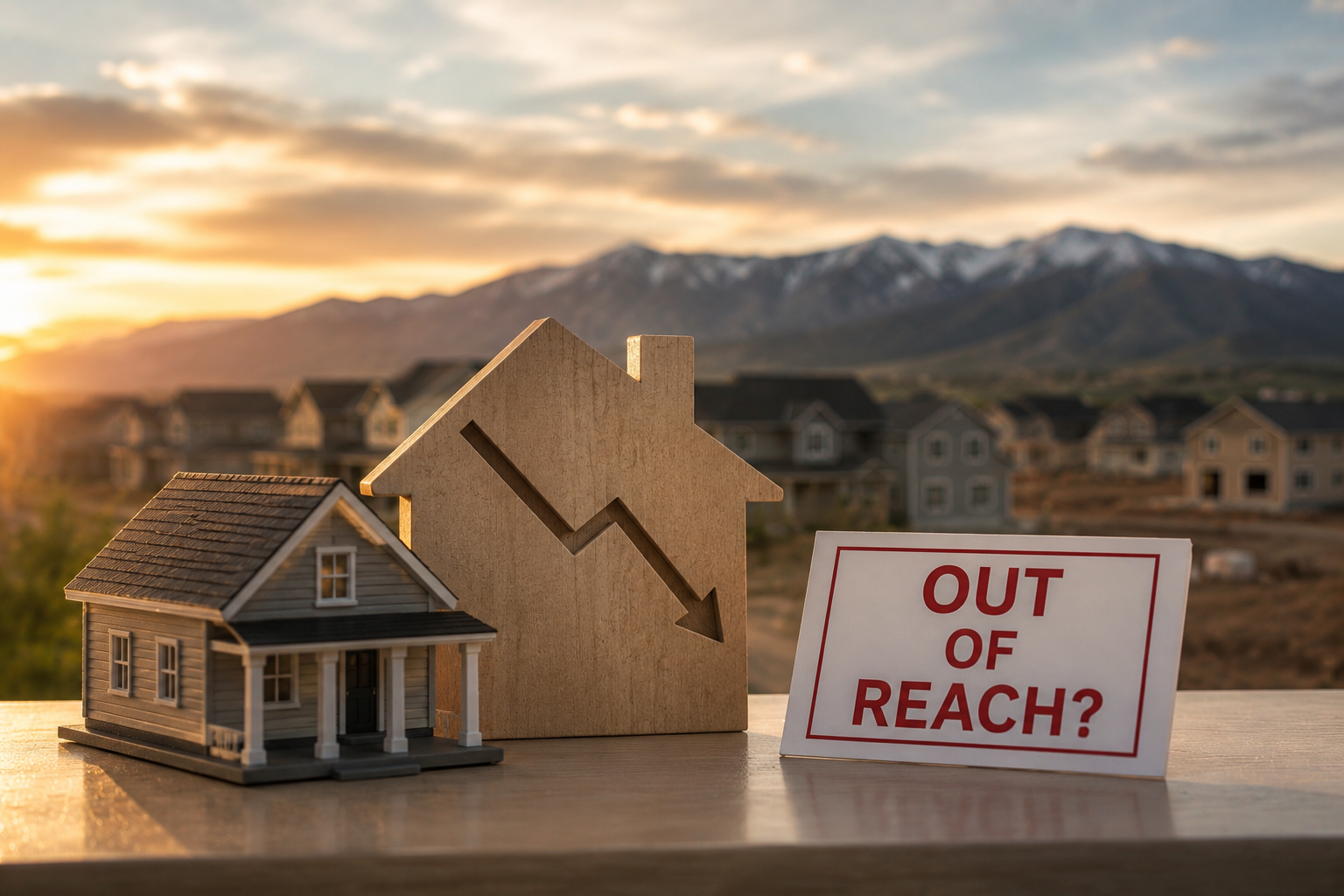
Utah's housing affordability crisis got a rare moment of public attention recently when the Salt Lake Home Builders Association hosted a major discussion at the Utah State Capitol. Gov. Spencer Cox, housing leaders, builders, and Realtors sat down together to talk plainly about what it will take to solve one of the state's most urgent problems.
The central message: Utah doesn't just need more housing — it needs different kinds of housing. Smaller homes. Attainable homes. Starter homes that let working families begin building equity instead of spending another decade renting.
Here's what that crisis actually looks like in numbers — and what it means for buyers in Utah County right now.
The Numbers Are Stark
Per the Utah Housing Strategic Plan, developed through a consensus process involving the state legislature, Governor's office, and housing stakeholders:
- Only 9% of Utahns can afford the median-priced home
- Utah needs 274,000 new housing units by 2033 to meet projected demand
- The median age of a first-time homebuyer in Utah is now 38 years old, per the National Association of Realtors
- Utah's homeownership rate has reached its lowest level in decades, ranking the state 30th nationally
Per the Deseret News/Hinckley Institute of Politics poll taken ahead of the 2026 legislative session, housing affordability was the No. 1 issue Utah voters wanted the Legislature to address — with 32% selecting it as their sole priority. That share was more than double the next-ranking topic.
In his January 2026 State of the State address, Gov. Cox pledged: "Utah will not become a state of renters." He called for pulling "every lever to increase the supply of housing — reform zoning, streamline permitting, support infrastructure and encourage innovation."
What the Capitol Discussion Was Really About
The Salt Lake Home Builders Association's Capitol event brought together Gov. Cox, housing advisors, builders, and Realtors to address a specific dimension of the shortage: it's not just about the number of homes being built, it's about the type.
Utah has been building plenty of large, expensive homes. What's missing are smaller, less expensive homes — the kind that used to let a young family get their first foothold in homeownership. The kind that cost under $400,000. The kind where a family of four could afford the mortgage on a combined household income.
Steve Waldrip, Gov. Cox's senior advisor for housing strategy and innovation, framed the problem directly in comments to KSL: "If you go back in history, we used to be able to get things approved very, very quickly. We've gotten away from that — and part of that is a result of the zoning process that we've created."
Waldrip also offered a striking geographic summary of why Utah's challenge is particularly difficult: per ESRI's housing profile of Utah, he describes Utah's development corridor as "everybody lives in a bobsled chute" — about 80% of Utah's population packed into a narrow 150-mile corridor along I-15. "We're not a Phoenix or Las Vegas or a Dallas where you can just keep sprawling," said University of Utah Gardner Policy Institute housing researcher Dejan Eskic.
The mountains hem in development. That geographic constraint makes every zoning decision — and every entitlement delay — more consequential than it would be in a flat, sprawling metro.
The 35,000 Starter Homes Goal — Where Things Stand
In January 2025, Gov. Cox announced a $185 million investment in affordable housing, with $150 million directed toward the "Utah First Homes" starter home initiative. The goal: 35,000 new starter homes across the state by December 2028, as part of a broader target of 150,000 total new housing units.
Per $300 million in subsidized builder loans that have been aligned behind the initiative, the strategy marks a deliberate shift toward single-family home construction to address affordability — rather than rent-subsidized apartments.
The reality check: as of mid-2025, only about 5,100 starter homes had been built or started since the governor's initiative launched. The state is behind schedule on a goal that was already described as a "moonshot."
One real-world success story from the initiative: NPR reported on the Potokar family, who qualified for a new development built by Nilson Homes — a 1,400 square foot two-story house priced under $400,000, part of the governor's push. Cole Potokar called it their "lucky chance at stability." The builder's waitlist is enormous. The window is narrow.
The Zoning Barrier: Why This Is Harder Than It Sounds
The core obstacle isn't lack of desire. It's the structure of the approval process itself.
Rep. Ray Ward, R-Bountiful, introduced HB184 during the 2026 legislative session — a bill that would have loosened local land use rules in larger counties, allowing residents to request exceptions to build smaller homes than zoning regulations currently allow. Per HousingWire's coverage, it would have given municipalities a fixed 30-day window to respond to smaller-lot requests, with automatic approval if they failed to respond.
The bill failed. The House Economic Development and Workforce Services Committee rejected it 3-6 in February 2026.
Ward's response: "It's my belief that unless the Legislature is willing to consider some larger ideas, we'll have a hard time making progress with our housing affordability problem. The way we have done zoning over decades has made things slow, has made things more expensive, and most importantly, has made it difficult for small homes to be built."
Rep. Cal Roberts highlighted another specific choke point: an estimated 180,000 "entitled" housing units across Utah — homes that have been zoned and approved by local governments — but for which building permits have not yet been requested or issued. Infrastructure is the bottleneck. Approved on paper, stalled in the ground.
Patrick Risk, a Salt Lake City residential land broker with Northmarq, put it plainly to HousingWire: "We desperately need more entry points into ownership, not just more units on a spreadsheet."
What did pass: HB68, which creates a new Division of Housing and Community Development within the Governor's Office of Economic Opportunity — centralizing and streamlining how housing policy is handled at the state level. Waldrip called it a step toward "more streamlined accountability."
What This Means for Buyers in Utah County Right Now
This is where the statewide policy conversation meets your specific situation.
The good news: Utah County — and Eagle Mountain in particular — is producing more attainable new construction than almost anywhere else on the Wasatch Front right now. Per May 2026 MLS data, Eagle Mountain's median single-family sold price was $524,900. Wander in Saratoga Springs sold homes ranging from $349,990 to $580,000. These are real options for buyers who have been priced out of Lehi or Salt Lake County.
The challenge: as my June 2026 Lehi market report showed, Lehi's median single-family price hit $701,900 in May — reflecting the Silicon Slopes premium that makes the county's most amenity-rich city increasingly out of reach for first-time buyers. The bifurcation between Lehi and Eagle Mountain is growing.
For buyers watching this issue:
Below $500K in new construction — Eagle Mountain is currently the most reliable entry point in Utah County for new construction under $500,000. Parkway Fields, Harmony 3, and Sweetwater all had closings in the $430K–$500K range in May 2026.
The $349K–$450K range — Wander in Saratoga Springs is currently the most active sub-$450K new construction neighborhood in the county. It absorbed 15 single-family closings in May 2026 alone, with 3-bedroom homes starting under $400,000.
Townhomes as an entry point — With single-family prices rising, the townhome market is increasingly where first-time buyers are finding their footing. Utah County's townhome median was $434,990 in May 2026. Lehi townhomes are moving in 21-day median DOM. Eagle Mountain townhomes at Towns at Brylee Farms sold 5 units at $389,900 median.
The window is narrow and may be closing. The 5,100 starter homes built statewide since the initiative launched represent a fraction of the 35,000 goal. When those units arrive — if the initiative succeeds — they will compete with existing attainable inventory. Buying before that supply arrives, at today's prices, may look very different from buying after.
The Honest Big Picture
Utah is facing a structural housing shortage driven by geography, population growth, zoning complexity, and infrastructure bottlenecks. As University of Utah researcher Dejan Eskic noted, the geographic reality of the Wasatch Front makes Utah's affordability challenge fundamentally different from sprawling metros — there is a hard physical ceiling on where development can go.
The state is taking this seriously at the highest levels. Gov. Cox has made housing his signature domestic issue. The Capitol discussion hosted by the Salt Lake Home Builders Association reflects a genuine coalition of builders, policymakers, and real estate professionals aligned on the urgency.
Progress is real. It is also slower than the problem requires.
For buyers in Utah County today: the most attainable options exist, and they are concentrated in specific neighborhoods and cities. Understanding where those options are — and what the trajectory looks like — is the most practical thing you can do with this policy context.
Let's talk about what's available in your budget right now →
Frequently Asked Questions
Why is housing so expensive in Utah? Utah's affordability crisis stems from several converging factors: rapid population growth, geographic constraints along the Wasatch Front that limit where development can go, zoning and entitlement processes that have become more complicated and time-consuming, infrastructure bottlenecks that delay approved projects, and elevated mortgage rates. Per the Utah Housing Strategic Plan, the state needs 274,000 new housing units by 2033 just to meet projected demand.
What is Gov. Cox's starter homes plan? Gov. Cox set a goal to facilitate 35,000 new "starter homes" across Utah by December 2028, as part of a broader target of 150,000 total new housing units. The initiative is backed by $300 million in subsidized builder loans. As of mid-2025, approximately 5,100 starter homes had been built or started — the state is behind schedule on the goal.
What percentage of Utahns can afford the median home price? Per the Utah Housing Strategic Plan, only 9% of Utahns can afford the median-priced home. Utah's homeownership rate has hit its lowest level in decades, ranking the state 30th nationally.
What is the most affordable new construction in Utah County in 2026? Eagle Mountain is currently the most affordable new construction market in Utah County for single-family homes, with a May 2026 median sold price of $524,900. Wander in Saratoga Springs had homes ranging from $349,990 to $580,000. For townhomes, Eagle Mountain's Towns at Brylee Farms had units closing around $389,900 and Saratoga Chase townhomes closed in the $362,999–$385,000 range.
What is HB184 and did it pass? HB184, sponsored by Rep. Ray Ward, would have loosened local zoning rules in larger counties to allow smaller homes on smaller lots — a direct attempt to create more starter home supply. It was rejected by committee in February 2026 by a 3-6 vote. The bill's failure was cited as a missed opportunity by housing advocates and the governor's office.
What did the Salt Lake Home Builders Association Capitol discussion conclude? The event brought together Gov. Cox, housing leaders, builders, and Realtors to address Utah's growing affordability and attainability crisis. The central theme: Utah doesn't just need more housing — it needs different kinds of housing that working families can realistically afford. Steve Waldrip, the governor's senior advisor for housing strategy and innovation, discussed how zoning and entitlement processes have become more complicated and time-consuming than they were decades ago, often requiring teams of consultants and attorneys to navigate.
Related reading:
- Eagle Mountain Real Estate Market Update: June 2026 Report by Neighborhood
- Lehi Real Estate Market Update: June 2026 Report by Neighborhood
- Saratoga Springs Real Estate Market Update: June 2026 Report by Neighborhood
- Should I Sell My Lehi Home in 2026? An Honest Breakdown for Rate-Locked Sellers
- Why Every New Home Builder Has Bad Reviews — and What That Means for Utah County Buyers
- How to Qualify to Buy a Home in Saratoga Springs Utah
Sources: Utah Housing Strategic Plan — only 9% of Utahns can afford median home, 274,000 units needed by 2033, median first-time buyer age 38; HousingWire — Utah homeownership rate at decades-long low, ranked 30th nationally, HB184 details, January 2026; KSL — HB184 rejected 3-6 by committee, Ward quote on zoning, February 2026; Deseret News — Steve Waldrip quotes on zoning approval timelines, 180,000 entitled but unbuilt units, Rep. Roberts infrastructure bill, January 2026; Deseret News/Hinckley Institute poll — housing affordability No. 1 issue for Utah voters, 32% sole priority, January 2026; Axios — Gov. Cox State of the State: "Utah will not become a state of renters," January 2026; ABC4 — $185M investment, $150M for Utah First Homes, 35,000 starter homes goal, statewide housing dashboard, January 2026; Yahoo Finance / NPR — 5,100 starter homes built or started as of mid-2025, Potokar family case study, Nilson Homes waitlist, September 2025; Utah Foundation — $300M subsidized builder loans, shift toward single-family starter home construction, Waldrip "Chicken Little" housing pitch, May 2024; ESRI / American Surveyor — Waldrip "bobsled chute" quote, Dejan Eskic on geographic constraints, June 2026; Deseret News — HB68 creates Division of Housing, Waldrip on streamlined accountability, March 2026; HJNews — Waldrip supply quotes, Roberts on 180,000 entitled units, January 2026; Salt Lake Board of Realtors — Capitol discussion with Gov. Cox, Salt Lake Home Builders Association, housing leaders, Realtors.
Written by Kat Ashby, Principal Broker and Realtor® at RootQuest Realty LLC in Saratoga Springs, Utah. Kat holds a Utah Division of Real Estate Principal Broker license (Credential #10382396-PB00) — a designation that requires demonstrated experience, additional coursework, and a separate licensing exam beyond the standard agent license. She has been actively selling in Utah County since 2020, with deep experience across Lehi, Eagle Mountain, Saratoga Springs, and the broader Wasatch Front, specializing in buyer and seller representation, new construction, and corporate relocation through Altair Global. She is fluent in English and Portuguese, earned her bachelor's degree in Psychology from Brigham Young University, and lives in the community she sells in.